“Vietnam business visa” can mean three different things: a business e-visa you apply for yourself, a DN visa that a Vietnamese company sponsors, or the work permit and LĐ visa you need to take a job. They are not interchangeable. This guide shows which one fits your trip, who applies for it, and what each one does not allow.
Vietnam business visa: the short version (November 2026)
- Meetings, trade fairs, negotiations, visiting suppliers for up to 90 days: a business e-visa usually fits, and no sponsor is needed.
- Longer or repeated work with one Vietnamese company: a DN1 visa, sponsored by that company, valid for up to one year.
- A job in Vietnam: a work permit (or a confirmed exemption) first, then an LĐ visa or a change of visa purpose.
- Our form sells the business e-visa for most passports, from US$70 including the government fee.
Which Vietnam business visa fits your trip?
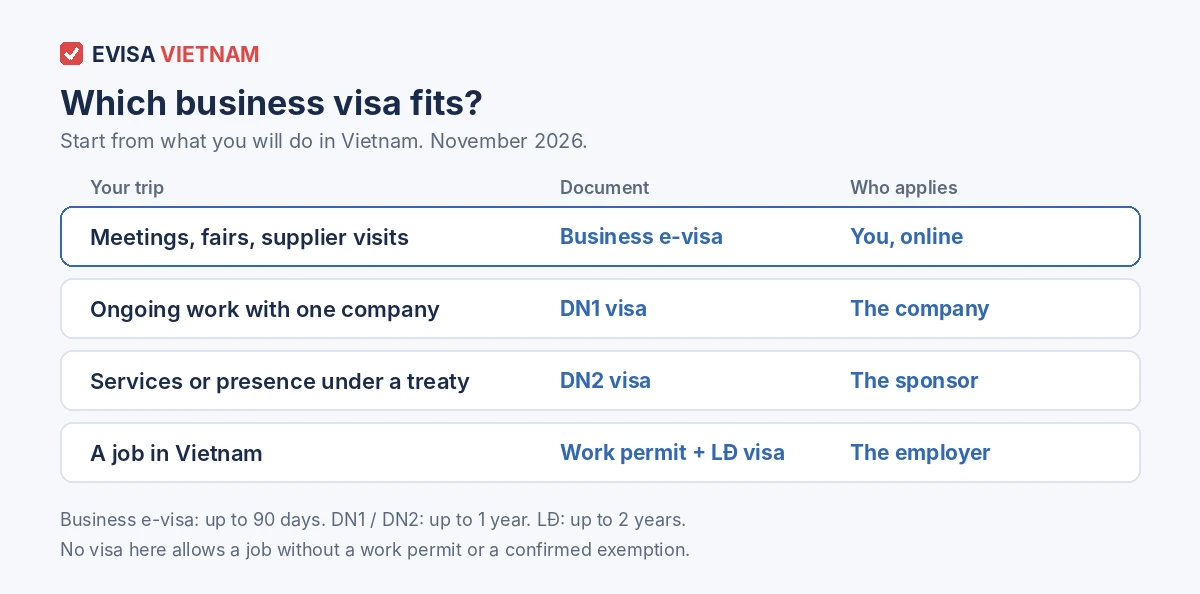
| Business e-visa (EV) | DN1 / DN2 visa | Work permit + LĐ visa | |
|---|---|---|---|
| Typical use | Meetings, conferences, trade fairs, contract talks, supplier visits | DN1: work with a company or organisation in Vietnam. DN2: offering services or setting up a commercial presence under a treaty | Employment in Vietnam |
| Who applies | You, online | The Vietnamese company or organisation (sponsor) | The employer, first for the work permit |
| Longest validity | 90 days | 1 year | 2 years (LĐ visa) |
| Entries | Single or multiple | Single or multiple | Single or multiple |
| Allows paid work in Vietnam? | No | No; a work permit is still needed for a job | Yes, for the job in the permit |
The business e-visa: for short trips you arrange yourself
The e-visa has a business purpose as well as a tourism one. It suits a trip where you meet people, inspect goods, attend an event or negotiate, and then leave. You apply for it yourself, without an invitation letter, and it can run for up to 90 days with one entry or several.
With our service, the business e-visa costs US$70 for 30 days with one entry and US$90 for 90 days, or US$100 and US$120 for several entries, government fee included. Standard processing takes four working days, with faster options. For a few passports our form offers only the tourism purpose; in that case the business e-visa is applied for directly on evisa.gov.vn. See the Vietnam visa cost guide for every price.
Choose the business purpose when the trip really is business. The purpose you declare should match what you do, and the border officer may ask.
DN1 and DN2 visas: when a company stands behind you
A DN visa is sponsored. The Vietnamese company or organisation files the request with the Immigration Department, and you then collect the visa abroad or at the border. The law defines two codes:
- DN1 for foreigners working with an enterprise or organisation that has legal status in Vietnam;
- DN2 for foreigners who come to offer services, set up a commercial presence or carry out other activities under a treaty Vietnam has signed.
Both can be valid for up to one year. That makes a DN visa the usual choice when your work with one partner runs longer than an e-visa allows, or when the partner prefers to sponsor you. A DN visa still is not a work permit: if the company employs you, the labour rules apply as well.
Working in Vietnam: work permit first, then the right visa
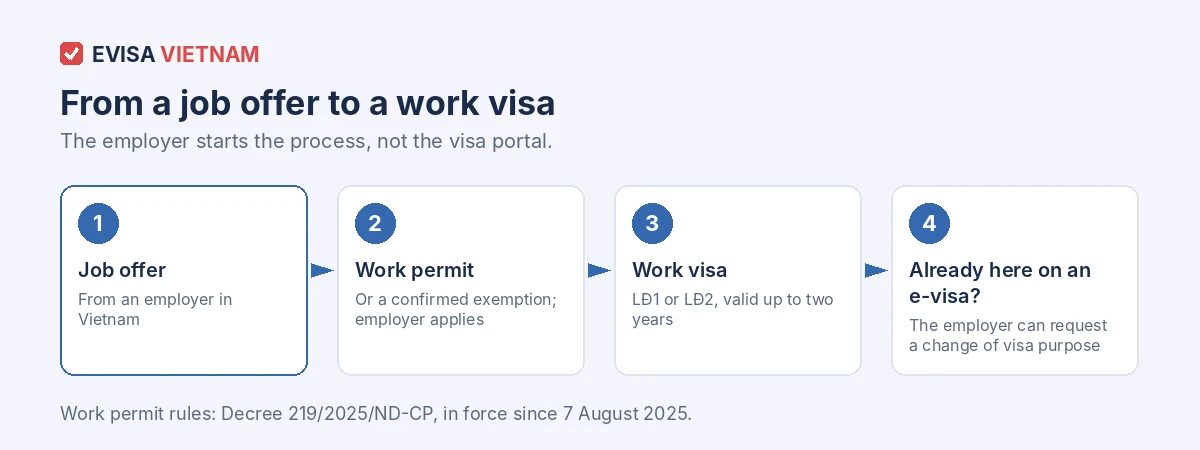
A foreigner who works for an employer in Vietnam needs a work permit, or a written confirmation that they are exempt. The current rules are in Decree 219/2025/ND-CP, in force since 7 August 2025. Among other changes, it lets managers, executives, experts and technical workers who work in Vietnam for less than 90 days in a calendar year use an exemption instead of a full permit, and it sets 10 working days for the authority to process a complete permit file.
With the permit or exemption in hand, the employer requests a work visa (LĐ1 for exempt workers, LĐ2 for permit holders), valid for up to two years. If you are already in Vietnam on an e-visa, the law lets you change the purpose of your visa once the permit or exemption is issued, without leaving the country. Our visa extension guide explains that procedure.
Business trips on a visa-free passport
If your passport is on Vietnam’s exemption list, you may not need a visa for a short business visit. The 45 days under Resolution 44/NQ-CP apply whatever the purpose of the trip, but the exemption added in August 2025 covers tourism only. Check your passport on our visa exemption page, and take a business e-visa when the visa-free rule does not cover your trip or your stay is longer.
Three trips, three answers
A buyer visiting factories twice in two months
Kenji, an Australian buyer, sources furniture from workshops near Ho Chi Minh City. He flies in for a week in March and again in April. One 90-day business e-visa with several entries covers both visits: US$120 with us, government fee included.
A consultant working with one client for six months
Laura advises a manufacturer in Hai Phong for six months, on site most weeks. The client sponsors a DN1 visa, which can cover the whole period. If the client hires her as staff instead of buying her services, it also needs a work permit or an exemption for her.
An engineer hired after a trade fair
Arjun came for a trade fair on a business e-visa and was offered a job. His new employer applies for his work permit; once it is issued, the employer requests a change of visa purpose so he can stay and work legally.
FAQ: Vietnam business visa
Can I attend a conference on a tourist e-visa?
Choose the business purpose for a business event. It costs a little more with us, and your declared purpose then matches what you do.
Do I need an invitation letter for a business e-visa?
No. You apply yourself. An invitation or sponsorship is needed for a DN visa.
Can I sign a contract on a business e-visa?
Negotiating and signing on behalf of your own company is ordinary business travel. Working for a Vietnamese employer is not, and needs a work permit.
How long does a work permit take?
The authority has 10 working days from a complete file under Decree 219/2025/ND-CP. Collecting the documents usually takes longer, so employers should start early.
We are an independent service, not a government website. Sources: Law on Entry, Exit, Transit and Residence of Foreigners in Vietnam No. 47/2014/QH13 as amended by Laws 51/2019/QH14 and 23/2023/QH15 (Articles 7, 8 and 9; official consolidated text); Labour Code 2019; Decree 219/2025/ND-CP on foreign workers (KPMG Vietnam summary); Government Resolution 44/NQ-CP and the August 2025 resolution on visa exemption. Prices from our apply form, November 2026. Last reviewed: 17 November 2026.