Short answer: the official Vietnam visa cost in 2026 is US$25 for a single-entry e-visa and US$50 for a multiple-entry e-visa, both valid for up to 90 days. Children under 14 pay a flat US$25 for any visa. Visa on arrival is single entry only: you pay US$25 in cash on arrival, plus the fee for the approval letter. If your passport is on the visa-free list, you pay nothing.
This guide shows every fee you can meet, with the legal source for each one. It also shows what four typical trips really cost, how to tell the government portal from an overpriced copy, and what you get back if a visa is refused. Our own prices sit next to the official fee, so you can decide whether you need help at all.
Key facts (updated 10 November 2026)
- E-visa government fee: US$25 single entry, US$50 multiple entry, up to 90 days.
- Children under 14: US$25 for any visa.
- Visa on arrival stamping fee: US$25, single entry only, cash on arrival.
- Legal basis: Circular 28/2026/TT-BTC, in force since 1 April 2026.
- The fee is the same for every nationality, and it is not refunded if a visa is refused.
Official Vietnam visa cost in 2026 (government fees)
Vietnam sets visa fees by circular from the Ministry of Finance. The current schedule is Circular 28/2026/TT-BTC, signed on 27 March 2026 and in force since 1 April 2026. It kept the earlier headline rates, so the US$25 and US$50 prices you may have seen before are still correct. The Government news portal published the full list on the same day.
The table lists the fees that go to the Vietnam Immigration Department. They do not include any agency service fee.
| Visa or service | Validity | Official fee |
|---|---|---|
| Single entry (e-visa or visa stamp) | Up to 90 days | US$25 |
| Multiple entry | Up to 90 days | US$50 |
| Multiple entry | Over 90 days, up to 180 days | US$95 |
| Multiple entry | Over 180 days, up to 1 year | US$135 |
| Multiple entry | Over 1 year, up to 2 years | US$145 |
| Multiple entry | Over 2 years, up to 5 years | US$155 |
| Multiple entry | Over 5 years, up to 10 years | US$165 |
| Child under 14 | Any validity | US$25 |
| Extension of stay | Per extension | US$10 |
| Visa exemption certificate (overseas Vietnamese and family) | Up to 5 years | US$10 |
Visas longer than 90 days need a sponsor in Vietnam, such as an employer or a family member. For that reason, most tourists only deal with the first two rows and the child rate. Foreigners who live in Vietnam often hold a temporary residence card instead. The card costs US$145 for up to 2 years, US$155 for over 2 to 5 years and US$165 for over 5 to 10 years.
Visas issued at Vietnamese embassies and consulates abroad follow the same rates under Circular 163/2026/TT-BTC, in force since 1 November 2026.
Vietnam e-visa cost: US$25 or US$50
The e-visa is now the main route for tourists. It is open to every nationality, and it lasts up to 90 days. You choose the entry type when you apply.
- Single entry, US$25: you enter Vietnam once. When you leave, the visa is used up.
- Multiple entry, US$50: you can leave and come back while the visa is valid. This suits trips that include Cambodia, Laos or Thailand.
- Child under 14, US$25: the same price for single or multiple entry. Each child still needs a separate application.
You pay online by international card on the official portal, evisa.gov.vn. Results usually arrive in about three working days, and there is no further fee on arrival. However, applications for 51 nationalities are currently paused or not being approved, so check the Vietnam visa requirements by nationality first. For photos, entry gates and every step, read our Vietnam e-visa guide.
Visa on arrival cost: approval letter plus stamping fee
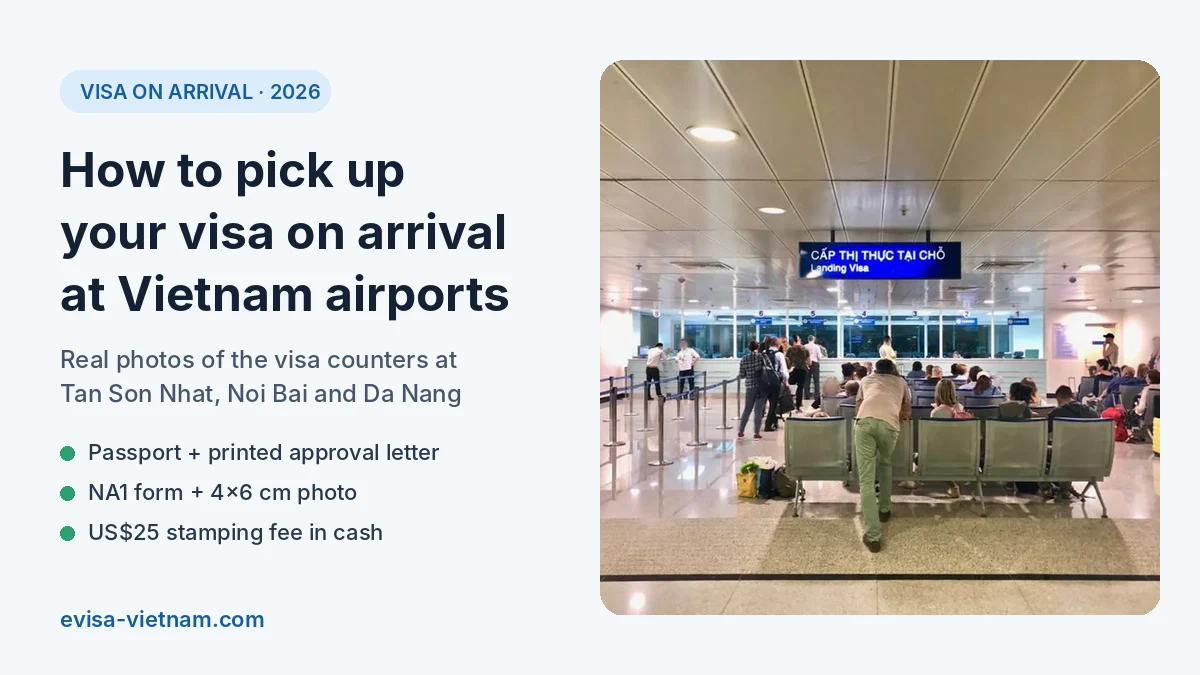
Visa on arrival is a two-part cost. First, a licensed agency obtains a visa approval letter for you. Then, at the border gate named on the letter, you pay the stamping fee in cash to the immigration officer.
- Approval letter: paid to the agency. The price depends on speed and visa length.
- Stamping fee: US$25, cash only, because visa on arrival is now single entry only. Clean US dollar notes are safest.
Because you pay twice, visa on arrival usually costs more than an e-visa. It is also for tourist trips and single entry only, and our letters cover stays of up to 15 days. That is why we now recommend it mainly for urgent trips. See how the letter works in our guide to the visa approval letter, and what happens at the counter in Vietnam visa on arrival.
Total Vietnam visa cost by route
The government fee is only part of the total. The comparison below shows what one adult really pays on each route.
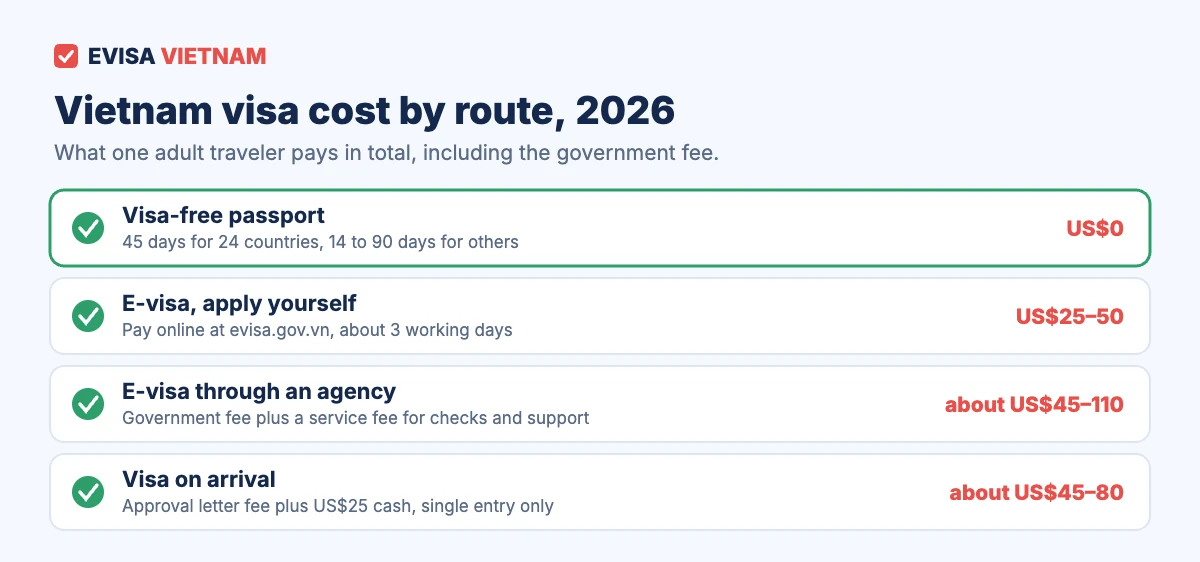
| Route | What you pay | Typical total | Best for |
|---|---|---|---|
| Visa-free entry | Nothing | US$0 | Eligible passports, short trips |
| E-visa, apply yourself | Government fee | US$25–50 | Confident travelers with time |
| E-visa through an agency | Government fee + service fee | About US$45–110 | Form checks, urgent cases, support |
| Visa on arrival | Letter fee + cash stamping fee | About US$45–80 | Urgent single-entry trips |
What four common trips really cost
These examples use the government fee only, so you can compare them with any quote you receive.
| Trip | Visas needed | Government fee |
|---|---|---|
| One traveler with a UK passport, 10 days | None, visa-free for 45 days | US$0 |
| A couple with US passports, 3 weeks, one entry | 2 single-entry e-visas | US$50 |
| A family of four with US passports, 2 adults and 2 children under 14, with a side trip to Cambodia | 2 adult multiple-entry e-visas (US$100) and 2 child e-visas (US$50) | US$150 |
| One traveler with an Indian passport, 60 days, one entry | 1 single-entry e-visa valid for up to 90 days | US$25 |
In short, if you have time and feel confident with the form, applying yourself is the cheapest option. On the other hand, a service makes sense when the trip is close, the form is complex, or a refusal would ruin expensive plans.
Our prices, shown openly
We are a private visa service, not a government website. You can always apply yourself at evisa.gov.vn for the official fee. If you prefer help, these are our current prices for a US passport, tourist purpose, standard processing. Each price already includes the government part of your Vietnam visa cost.
| Service | Our total price | Of which government fee |
|---|---|---|
| E-visa, 30 days, single entry | US$60 | US$25 |
| E-visa, 30 days, multiple entry | US$90 | US$50 |
| E-visa, 90 days, single entry | US$80 | US$25 |
| E-visa, 90 days, multiple entry | US$110 | US$50 |
| Visa on arrival letter, 15 days, single | US$30 + US$25 cash on arrival | US$25 (cash on arrival) |
The same prices apply to most passports, including those from the UK, Canada, Australia, India and mainland China. However, three things can change your total Vietnam visa cost. Our application form shows the exact amount before you pay.
1. Faster processing
Standard processing takes 4 working days. So if you need your visa sooner, you can pay for a faster option.
| Processing time | E-visa | Approval letter |
|---|---|---|
| 4 working days | No extra fee | No extra fee |
| 3 working days | +US$20 | Not offered |
| 2 working days | +US$40 | +US$40 |
| 1 working day | +US$100 | +US$70 |
| 4 working hours | +US$130 | +US$110 |
Working days exclude Saturdays, Sundays and Vietnamese public holidays. Moreover, during some holidays the form shows a separate holiday rate.
2. Business purpose
For most passports, a business e-visa costs US$10 more than a tourist e-visa. For example, a 30-day single-entry business e-visa costs US$70.
3. Your nationality
In addition, some passports have a higher price. The table below compares our tourist e-visa prices, with standard processing, for most passports and for passports such as Egypt, Israel, Jordan, Nepal and Ukraine.
| E-visa | Most passports | Egypt, Israel, Jordan, Nepal, Ukraine and some others |
|---|---|---|
| 30 days, single entry | US$60 | US$80 |
| 30 days, multiple entry | US$90 | US$110 |
| 90 days, single entry | US$80 | US$85 |
| 90 days, multiple entry | US$110 | US$110 |
Also, for these passports, faster processing has its own fees, from US$15 to US$135 extra. Similarly, our form does not offer visa approval letters for these passports.
Our fee covers a document check, submission, follow-up with you, and a refund under our refund policy if the visa is not granted for reasons outside your control.
How to avoid paying too much for a Vietnam visa
Many websites sell Vietnam visas, and some look like government pages. Paying an agency is legal, but you should know what you are paying for. Run these five checks before you enter your card details.
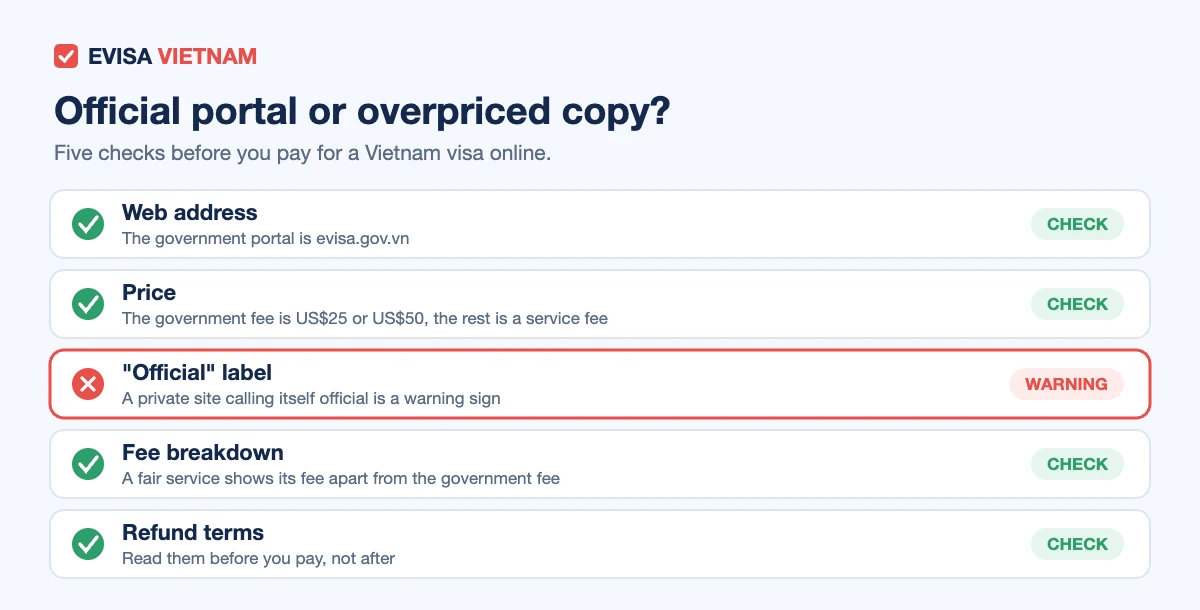
- Check the address. The government portal is evisa.gov.vn. Any other address is a private website.
- Compare the price. The government fee is US$25 or US$50. Everything above that is a service fee.
- Be careful with the word “official”. A private site that presents itself as the government is a warning sign.
- Look for a fee breakdown. A fair service shows its own fee apart from the government fee, as we do above.
- Read the refund terms first. Know what happens if the visa is refused or delayed before you pay.
Refunds: what you get back if a visa is refused
The government fee is not refunded if your e-visa is refused, or if you made a mistake in the form. As a result, a typo in a passport number can cost you a second fee. An agency may refund its own service fee, depending on its policy. Ours is explained in our refund policy.
Hidden costs most travelers forget
- Card fees: some banks add a foreign transaction fee when you pay online.
- Cash for the stamp: visa on arrival counters take cash only. Bring small US dollar notes.
- Photos: visa on arrival needs a 4×6 cm photo. Bring your own to avoid delays.
- Mistakes: a wrong passport number or date can mean a new application and a second fee.
- Overstaying: under Decree 282/2025/ND-CP, fines start at VND 0.5–2 million for less than 16 days and reach VND 30–40 million for a year or more, and you may be deported.
Can you avoid the Vietnam visa cost completely?
Yes, in two common cases. First, citizens of 39 countries can enter without a visa. For example, 24 countries, including the UK, Germany, France, Japan and South Korea, get 45 days. Second, any foreign visitor can stay on Phu Quoc island for up to 30 days without a visa when arriving there directly from abroad. Check the full list in our guide: who is exempted from Vietnam visa.
Other costs to know before you enter Vietnam
Foreigners landing at Tan Son Nhat, Noi Bai, Da Nang, Phu Quoc or Cam Ranh airports must submit a Digital Arrival Card within 72 hours before landing. It is free on the official site, prearrival.immigration.gov.vn, so you never need to pay an agency for it. Also, if you want to stay longer once you are in Vietnam, the government fee for an extension is US$10, where an extension is allowed.
FAQ: Vietnam visa cost
How much is a Vietnam visa for US citizens?
The government fee is US$25 for a single-entry e-visa or US$50 for multiple entry, and US$25 for a child under 14. US citizens are not visa-exempt, so every traveler needs a visa. Read more in our guide to the Vietnam visa for US citizens.
Is the Vietnam visa fee different by nationality?
No. The official fee is the same for all nationalities. However, agency prices can differ, because some passports need more checks.
Do children pay the same visa fee?
Not always. Children under 14 pay a flat US$25 for any visa, so a child’s multiple-entry e-visa costs US$25 instead of US$50. Each child, including babies, still needs their own application.
Is the e-visa fee refundable?
No. The government does not refund the fee if your e-visa is refused or contains errors. Check every field before you pay.
Can I pay the stamping fee by card at the airport?
No. Visa on arrival counters accept cash only. US dollars are the safest choice.
Is a multiple-entry visa worth the extra US$25?
Only if you will leave and re-enter Vietnam during the trip. For a simple round trip, the single-entry visa is enough.
Sources: Circular 28/2026/TT-BTC (Ministry of Finance, 27 March 2026); Viet Nam Government News, 1 April 2026; the official e-visa portal evisa.gov.vn; Government Resolutions 44/NQ-CP and 229/NQ-CP on visa exemption; our own visa on arrival cases (November 2026). Last reviewed: 10 November 2026. We are an independent visa service, not a government website.