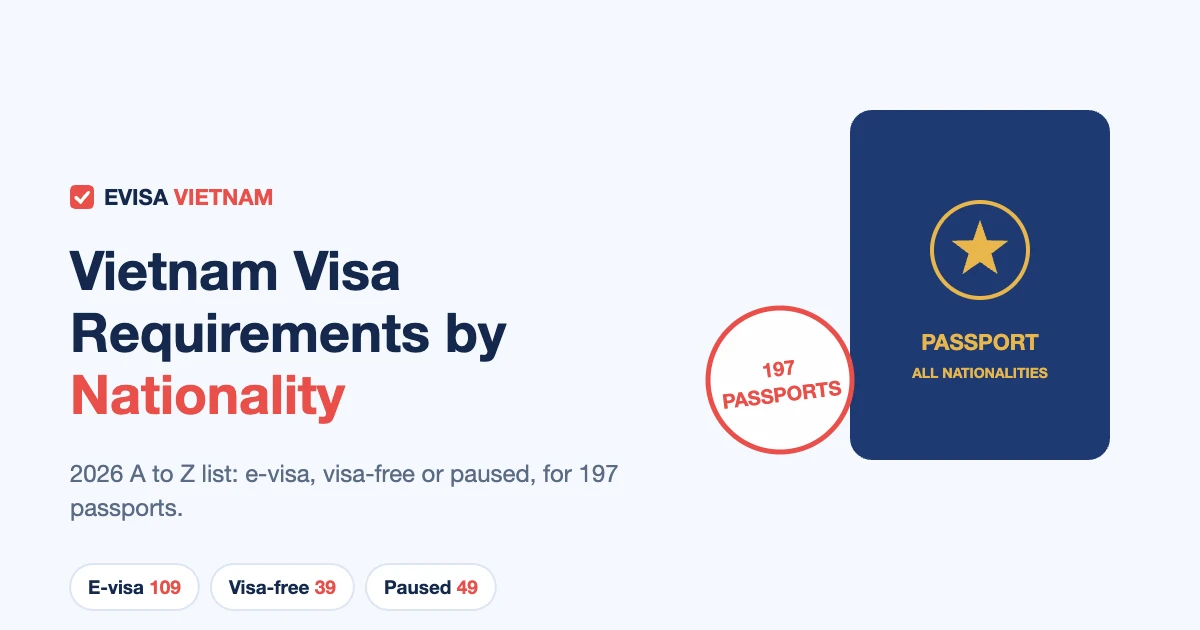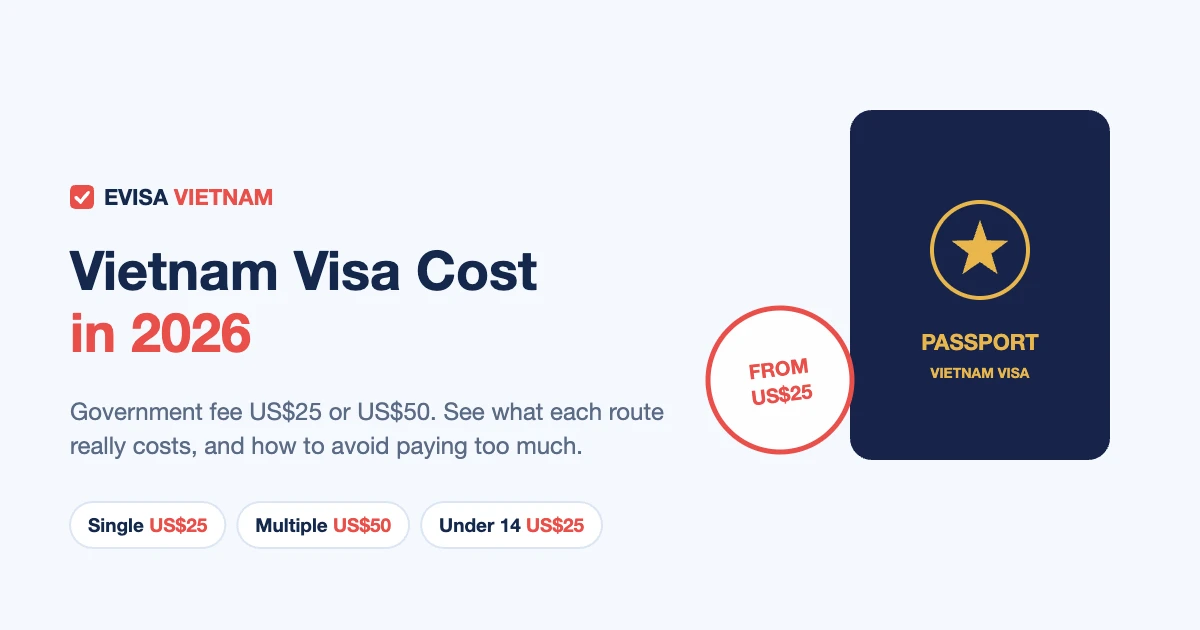
The Vietnam evisa is an electronic visa issued by the Vietnam Immigration Department. Since 15 August 2023 it has been open to citizens of every country and territory. It lasts up to 90 days, allows single or multiple entry, and costs US$25 or US$50 (US$25 for children under 14). You apply online, receive a PDF, print it and travel, with no embassy visit and no airport visa desk.
This guide is the complete reference: who needs a Vietnam evisa, the documents and photo rules, the application step by step, how to check your status, how to read the e-visa before you fly, what to do if it is late, and where you can enter. Each of our country guides links back here for these steps.
Vietnam evisa in one minute (November 2026)
- Who: every nationality, unless your passport is visa-free for your trip.
- Length: up to 90 days, single or multiple entry.
- Fee: US$25 single, US$50 multiple, US$25 for children under 14.
- Official portal: evisa.gov.vn. Processing: about 3 working days.
- Valid at 83 gates: airports, land borders and seaports.
Who needs a Vietnam evisa?
You need a Vietnam evisa if your passport is not on the visa-free list, or if your trip is longer than your visa-free limit. For example, travelers from the United States, Australia, Canada, India and China need a visa for any tourist trip. A British or German traveler, by contrast, can stay 45 days visa-free, but needs an e-visa to stay longer. Check your passport in our Vietnam visa requirements by nationality list.
The e-visa is open to every nationality by law, under Law 23/2023/QH15 and Government Resolution 127/NQ-CP. In practice, however, applications on 51 passports are currently paused or not being approved. Read nationalities that cannot get a Vietnam visa before you pay.
Vietnam evisa requirements
Documents
- A passport valid for at least six months from your entry date, with blank pages.
- A scan or photo of the passport data page. It must show the whole page, including the two lines of letters and numbers at the bottom (the MRZ).
- A portrait photo: recent, colour, white background, facing the camera, no glasses.
- Your planned entry date, entry gate and exit gate.
- An address in Vietnam, such as your first hotel.
- An international payment card.
Photo rules that cause most refusals
- Do not crop the portrait from the passport page. Take a separate photo.
- Avoid glare on the passport page, and keep all four corners visible.
- No hats, glasses or filters.
Our Vietnam visa photo requirements guide shows good and bad examples.
How to apply for a Vietnam evisa in 5 steps
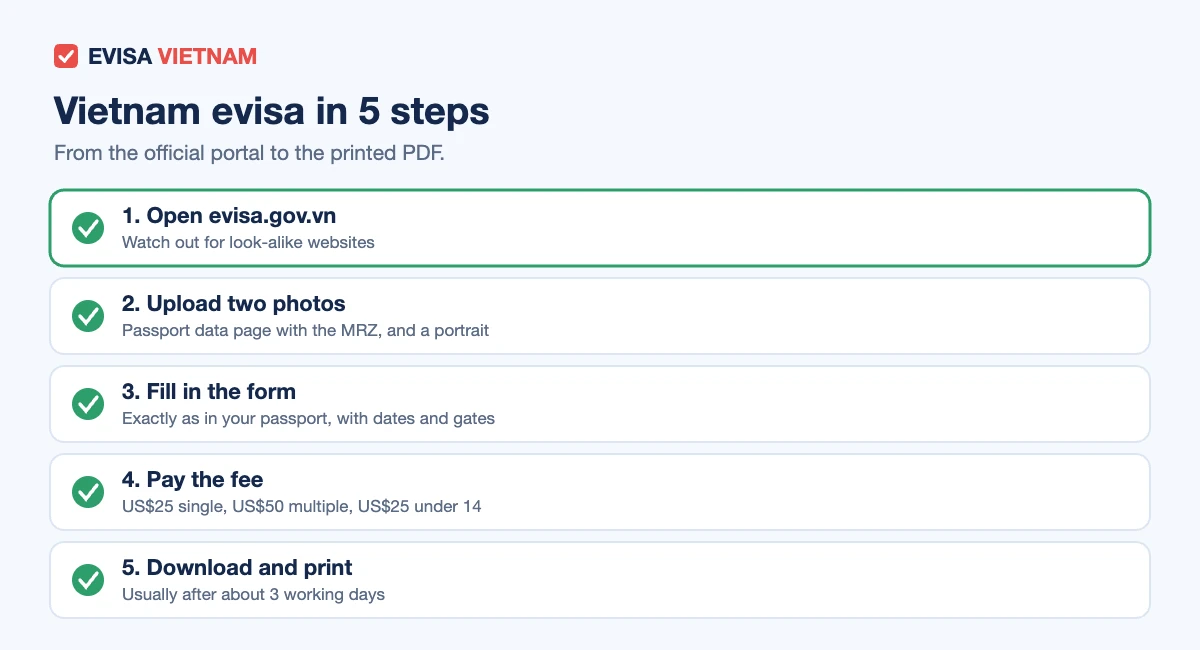
- Open the official portal, evisa.gov.vn. Be careful with look-alike websites. Private services such as ours must say clearly that they are not the government.
- Upload your photos: the passport data page and the portrait.
- Fill in the form exactly as in your passport. Choose single or multiple entry, the validity dates and your entry and exit gates.
- Pay the fee: US$25 for single entry, US$50 for multiple entry, US$25 for a child under 14. Save your registration code.
- Download and print the e-visa PDF when it is approved, usually after about three working days.
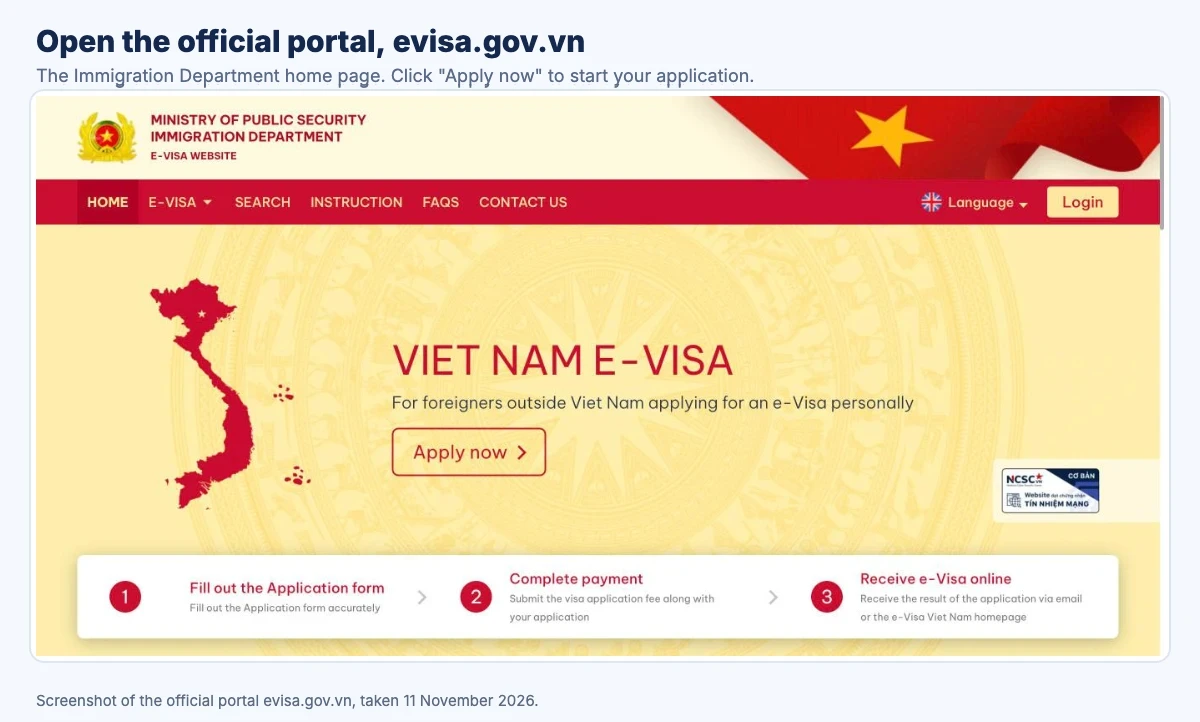
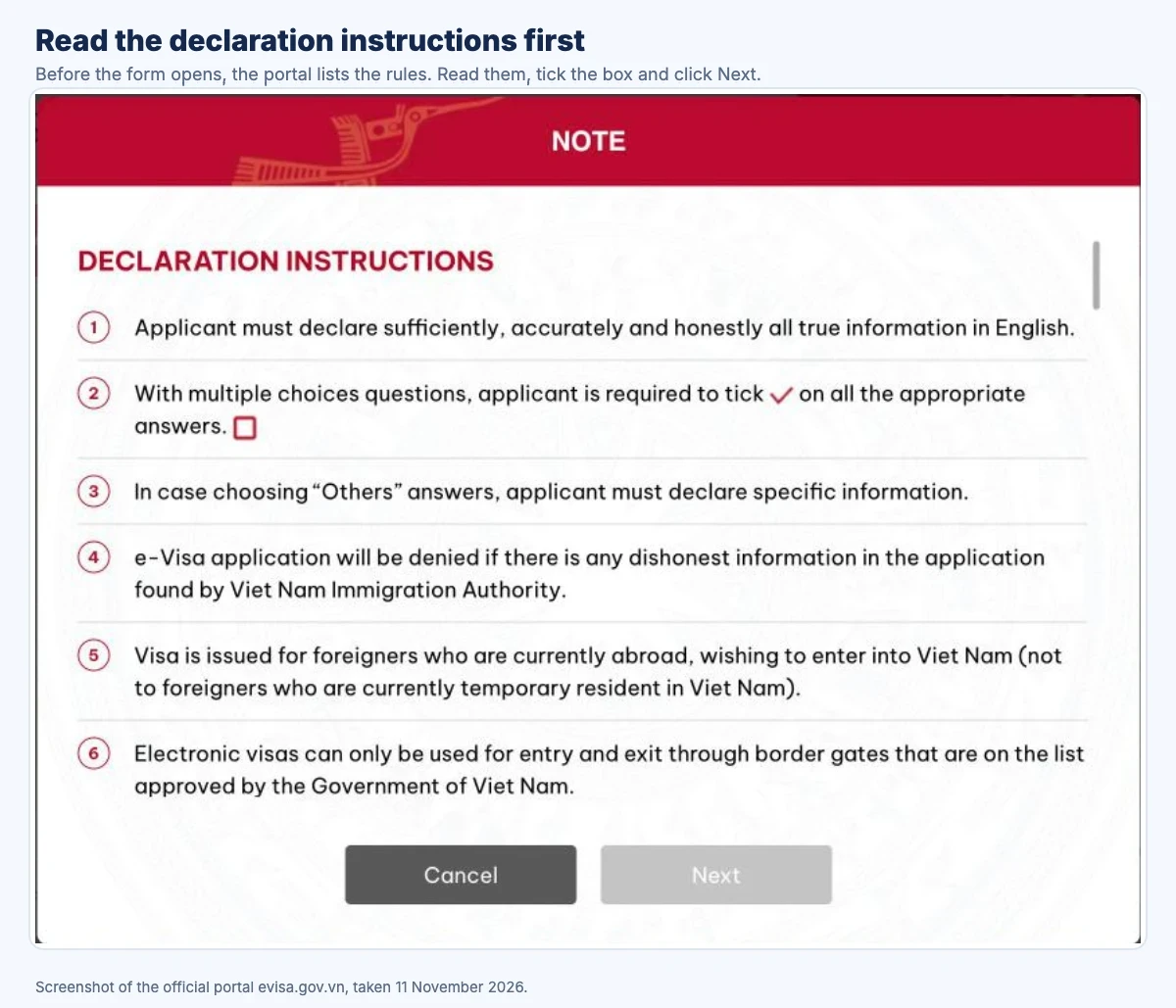
Finally, if you land at Tan Son Nhat, Noi Bai, Da Nang, Phu Quoc or Cam Ranh, you must submit the free Digital Arrival Card within 72 hours before landing on prearrival.immigration.gov.vn.
How to check your Vietnam evisa status
You check the result on the same portal where you applied. Therefore, keep the registration code and the email address you used, because you need them to search.
- Open evisa.gov.vn and click SEARCH in the top menu.
- Enter your e-Visa app no. (registration code), the email address and the date of birth from your application, plus the security code.
- Read the status. If it is approved, download the PDF. If the portal asks you to correct or add information, do it as soon as possible, because the clock does not move while it waits for you.
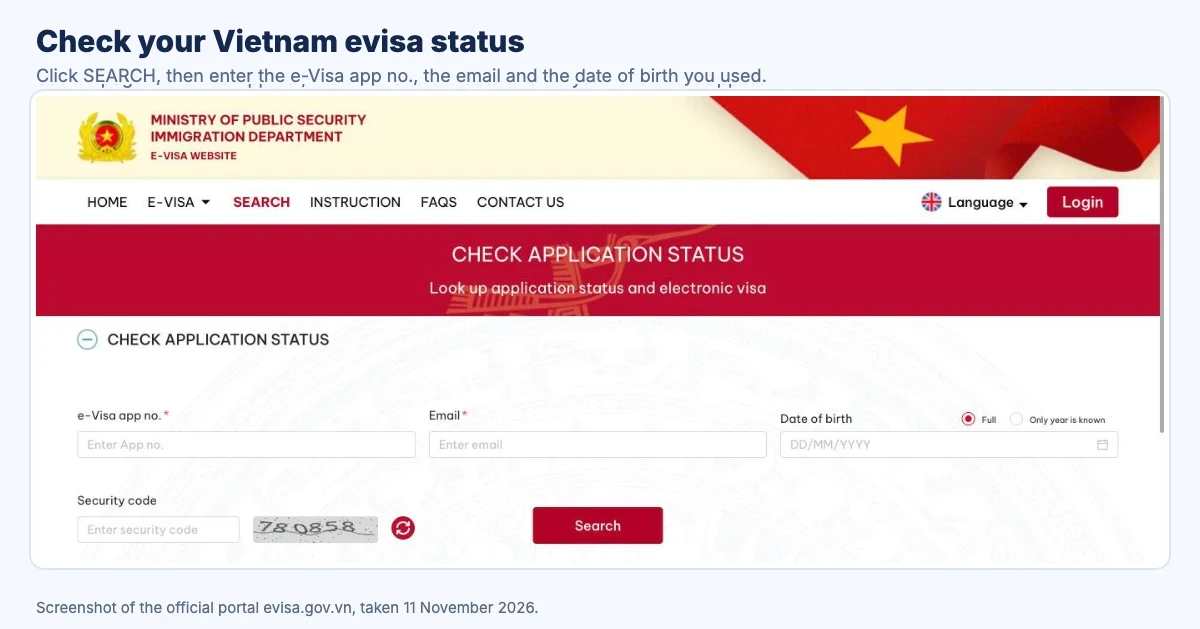
Check the portal every working day once your application is in, rather than waiting for an email. In our experience, two things surprise travelers. First, a payment can take up to two hours to show as paid, so do not pay a second time. Second, the portal does not show a “refused” label. If it keeps asking for amendments or more information and never approves, treat the application as refused and apply again in good time. If you applied through a service, the service follows up for you.
Read your Vietnam evisa before you fly
An approved e-visa can still contain a mistake, for example a wrong date or a swapped name. Compare the PDF with your passport and your tickets the day you receive it.
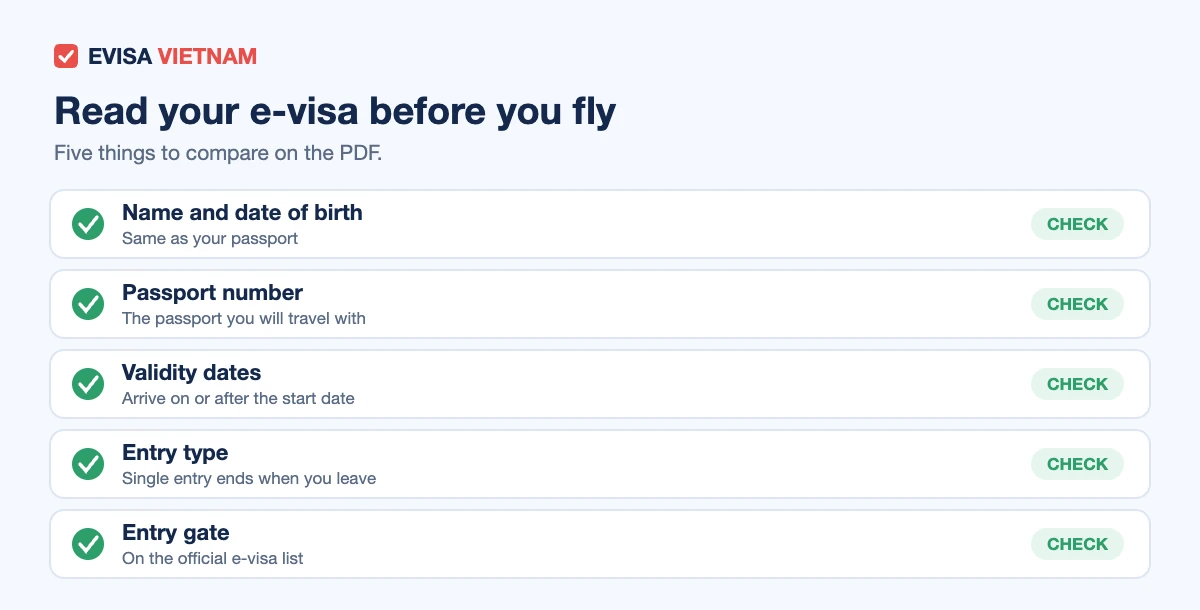
| On the e-visa | Compare with | Why it matters |
|---|---|---|
| Full name and date of birth | Your passport | A mismatch can stop you at check-in or at immigration |
| Passport number | The passport you will travel with | A new passport needs a new e-visa |
| Validity from and to | Your arrival and departure dates | You cannot enter before the start date or stay after the end date |
| Entry type | Your plans | Single entry ends when you leave Vietnam |
| Entry gate | Your first airport, land border or seaport | The PDF no longer prints a gate: use a listed gate of the type you chose |
Vietnam evisa processing time, and what to do if it is late
Most applications are decided in about three working days. Weekends and Vietnamese public holidays do not count, and waits get longer around Lunar New Year. In 2027, government offices close from Thursday 4 to Wednesday 10 February, so apply in January for a February trip. Therefore, apply at least one to two weeks before your flight. Our Vietnam visa processing time guide shows how the days are counted.
If your flight is close and the e-visa has not arrived:
- First, check the status on the portal, in case it asks you to correct something.
- Then, check the details you entered. An error means a new application, and the first fee is not refunded.
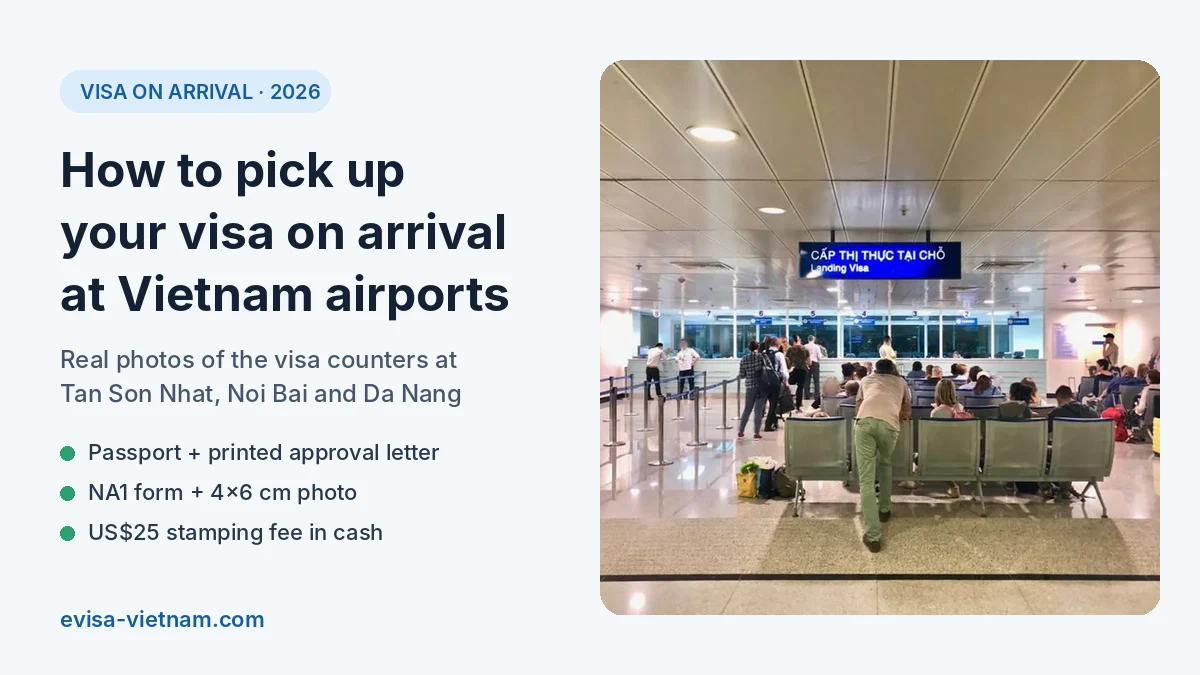
- If you travel in one or two working days, an urgent visa approval letter is a possible backup. It gives a 15-day, single-entry visa on arrival. See Vietnam visa on arrival.
- Do not book a second e-visa on another site without checking the first, because you would pay twice.
An experienced service can prepare a clean application and follow up. However, nobody can guarantee the government’s decision.
Vietnam evisa cost
The government fee is US$25 for single entry and US$50 for multiple entry, and US$25 for children under 14 whatever the entry type. It is the same for all nationalities and is not refunded if the application is refused. Our full Vietnam visa cost guide compares all routes, including our own prices.
Where you can enter with a Vietnam evisa
In December 2025, Vietnam added 41 border gates to the e-visa system, bringing the total to 83, as Viet Nam News reported. The new gates include 4 airports, 11 land borders and 26 seaports. The new airports are Long Thanh (Dong Nai), Gia Binh (Bac Ninh), Vinh (Nghe An) and Chu Lai (Da Nang). Long Thanh and Gia Binh join once they open, and Long Thanh is due to start commercial flights on 24 December 2026.
- Main airports: Noi Bai (Hanoi), Tan Son Nhat (Ho Chi Minh City), Da Nang, Cam Ranh, Phu Quoc, Cat Bi, Can Tho, Phu Bai (Hue), Van Don, Lien Khuong and others.
- Land borders: major crossings with China, Laos and Cambodia, such as Moc Bai, Lao Bao and Huu Nghi.
- Seaports: including Hai Phong, Da Nang, Nha Trang and Ho Chi Minh City.
Since late 2025, the e-visa PDF no longer prints an entry gate. Our advice: if you chose an airport, you can land at any airport on the e-visa list. If you chose a seaport or land border, enter through that gate. See every gate in our guide to Vietnam e-visa ports of entry.
Vietnam evisa vs visa on arrival
The e-visa is cheaper, because you skip the approval letter fee. It is also faster on arrival, because you go straight to passport control. Moreover, it works at land and sea borders. Visa on arrival remains useful for some urgent single-entry trips; see our guide to the visa approval letter.
Common Vietnam evisa mistakes
- Wrong passport number, or the letter O instead of zero.
- Name order different from the passport, or a missing middle name.
- An entry date earlier than your real arrival. You may arrive on or after the start date, not before.
- Choosing single entry when you plan a side trip to Cambodia or Laos.
- Applying on an unofficial site without realising it.
Overstaying a Vietnam evisa: the fines
Leave Vietnam on or before the last day shown on your e-visa. Under Decree 282/2025/ND-CP, in force since 15 December 2025, an overstay is fined by its length, and you may also be deported.
| Overstay | Fine (VND) |
|---|---|
| Under 16 days | 0.5–2 million |
| 16 to under 30 days | 5–10 million |
| 30 to under 60 days | 10–15 million |
| 60 to under 90 days | 15–20 million |
| 90 to under 180 days | 20–25 million |
| 180 days to under 1 year | 25–30 million |
| 1 year or more | 30–40 million |
Therefore, if your plans change, sort out your status before the e-visa ends, not at the airport on the way out.
FAQ: Vietnam evisa
Can I extend a Vietnam evisa?
Generally, a tourist e-visa cannot be extended inside Vietnam. Plan the full stay, up to 90 days, when you apply.
Is a printed copy required?
Yes. Carry a printed copy of your Vietnam evisa. Some airlines also check it at departure.
Do children need their own e-visa?
Yes. Every child needs a separate application. Children under 14 pay US$25, even for multiple entry.
I renewed my passport after my e-visa was approved. Is it still valid?
No. The e-visa is linked to the passport number. You need a new e-visa for the new passport.
My e-visa is still “in processing”. What can I do?
Check the portal for any request to correct details, and keep your registration code. If your flight is very close, contact us, and we can advise on options such as an urgent visa approval letter.
Sources: Vietnam Immigration Department e-visa portal (evisa.gov.vn); Law 23/2023/QH15; Government Resolution 127/NQ-CP (2023); Circular 28/2026/TT-BTC (fees); Viet Nam News on the 41 new e-visa gates (December 2025); Ministry of Home Affairs notice 11483/TB-BNV (Tet 2027 holiday); VietnamPlus on Long Thanh airport (October 2026). Last reviewed: 10 November 2026. We are a private visa service, not a government website.