A Vietnam visa extension is possible, but not as a form you fill in yourself. Under Vietnam’s immigration law, a longer stay is requested by the company, organisation or person in Vietnam that sponsors you, and the Immigration Department decides. If nobody can sponsor you, the legal way to stay longer is to leave before your permitted stay ends and come back on a new visa, or visa-free if your passport qualifies.
This guide explains what the law actually says for each way of entering Vietnam, what a sponsor files, what it costs, and what happens if you stay past your date.
Vietnam visa extension: the short answer (November 2026)
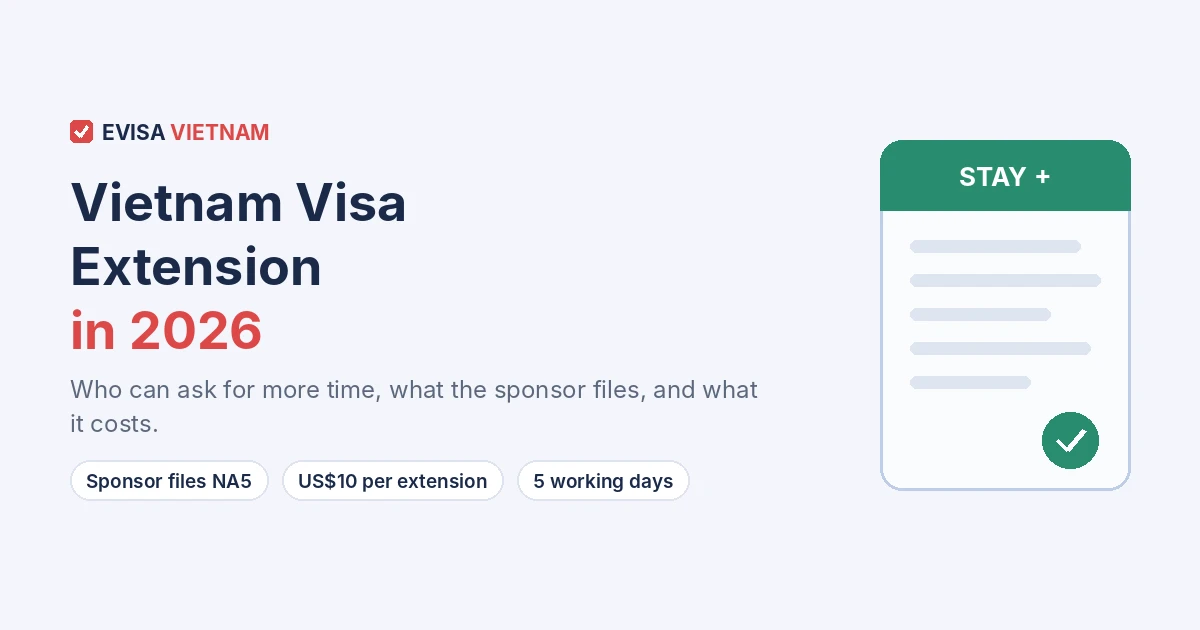
- You cannot request an extension on your own. Your sponsor in Vietnam files it (Article 35 of the immigration law).
- The sponsor submits form NA5 with your passport. The authority answers within five working days of a complete file.
- Government fee: US$10 per extension (Circular 28/2026/TT-BTC).
- Some visa holders can change the purpose of their visa instead, such as after getting a work permit.
- Our application form does not sell extensions. It sells new e-visas for a future entry.
Can you extend a Vietnam visa? It depends on how you entered
The stamp you received at the border decides your options. Find your case in the table, then read the steps below it.
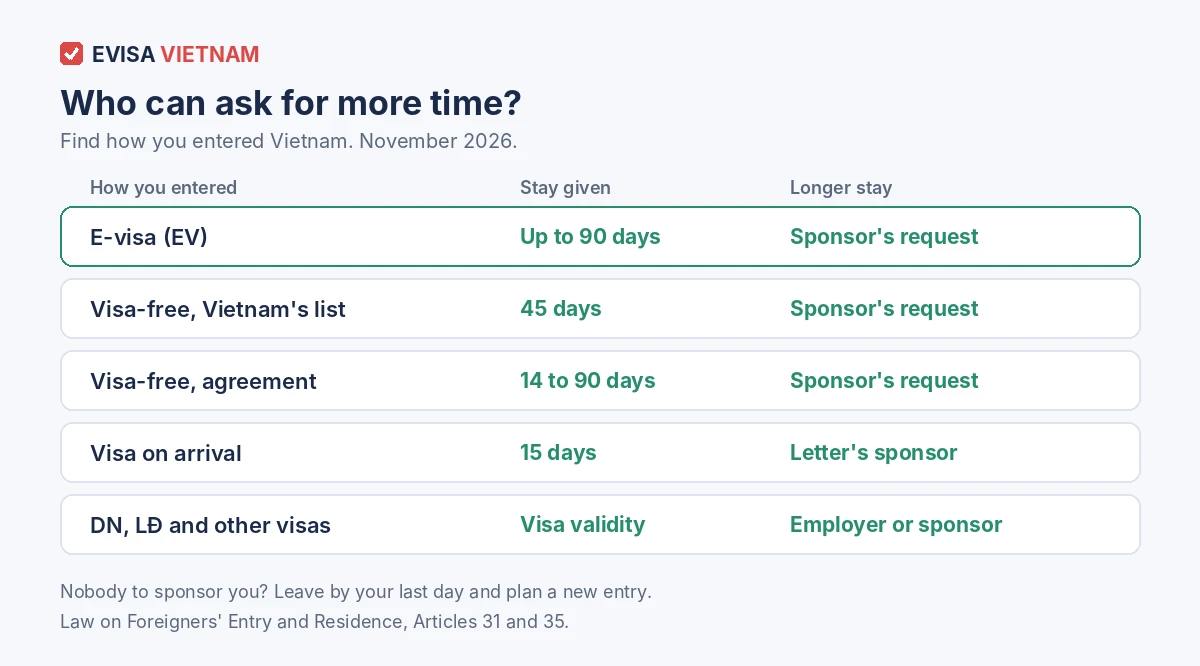
| How you entered | Stay you were given | Longer stay inside Vietnam? |
|---|---|---|
| E-visa (code EV) | The dates on your e-visa, at most 90 days | Only if a sponsor in Vietnam requests an extension for you |
| Visa-free, on Vietnam’s own exemption list | 45 days | The law says a visa or an extension “will be considered”, which again means a request from a sponsor |
| Visa-free under a bilateral agreement | The days set by the agreement (14 to 90 days, depending on the passport) | Through a sponsor; the agreement itself gives no extra days |
| Visa on arrival (stamp issued at the border) | 15 days, one entry (the approval letter we offer) | Through the company that sponsored your approval letter |
| Business, work or other sponsored visa (DN, LĐ …) | The visa’s validity | Through your employer or sponsor |
One detail is easy to miss. A tourist visa coded DL that is valid for more than 30 days only gives you 30 days at each entry, and further time is handled as an extension (Article 31). An e-visa is coded EV, not DL, so it gives you the whole period printed on it.
How a Vietnam visa extension is requested
The procedure is the same for every visa type that can be extended. You do not appear in it as the applicant; your sponsor does.
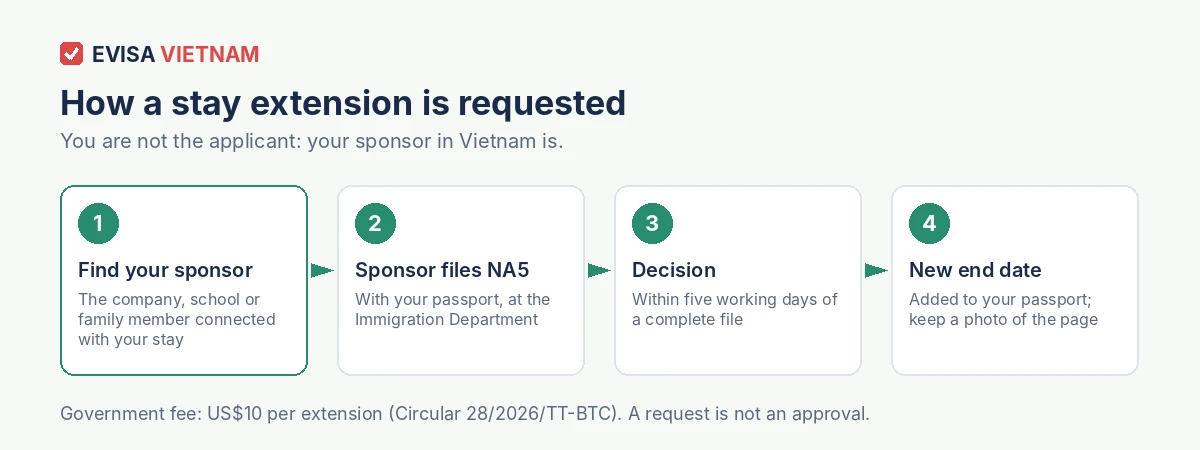
- Find your sponsor. This is the agency, organisation or person in Vietnam that invited you or now agrees to sponsor you. A company you work with, a school that enrols you, or a family member in Vietnam can sponsor their own guest. The sponsor must be the one connected with your stay.
- The sponsor files the request. It submits form NA5 (request for a visa or a stay extension, Circular 22/2023/TT-BCA) together with your passport to the Immigration Department. Diplomatic and official cases go to the Ministry of Foreign Affairs.
- Wait for the decision. The law gives the authority five working days from the day it has a complete file. Your passport stays with the file during that time, so plan hotel check-ins and domestic flights around it.
- Pay and collect. The government fee for a stay extension is US$10 each time. The new end date is added to your passport.
A request is not an approval. The authority can refuse it, and nothing in the law obliges it to grant extra time. Apply well before your current end date, never on the last day.
Changing your visa purpose instead
A visa cannot normally be used for a different purpose. Article 7 of the law lists four exceptions, where you receive a new visa that matches the new purpose without leaving Vietnam:
- you are an investor, or represent a foreign organisation that invests in Vietnam;
- you are the father, mother, spouse or child of the person who invites or sponsors you;
- a Vietnamese agency or organisation invites you and you hold a work permit, or a confirmation that you do not need one;
- you entered on an e-visa and now hold a work permit, or a confirmation that you do not need one.
None of these covers a longer holiday. They are meant for people whose reason for being in Vietnam has really changed, and the employer or sponsor still files the paperwork.
No sponsor? Leave in time and plan your next entry
A traveller on a holiday e-visa usually has no one in Vietnam who can file for them. In that case:
- Leave on or before your last permitted day. The end date on an e-visa does not move, even if you arrived late.
- A new e-visa is a separate application. It has its own dates and its own entry. Choose dates that start after the trip in which you leave Vietnam, and allow for processing: our standard service takes four working days, and there are faster options. See Vietnam visa processing time.
- Check whether you can return visa-free. Your passport may be on the visa exemption list, with its own number of days.
- Next time, buy the length you need. An e-visa can run for up to 90 days, with one entry or several. Picking 90 days at the start avoids the whole problem. Our totals start at US$60, government fee included; the Vietnam visa cost guide shows every option.
What overstaying costs
Staying even one day past your date is an administrative offence. Under Decree 282/2025/ND-CP, in force since 15 December 2025, fines start at VND 500,000 for less than 16 days and rise to VND 30–40 million for a year or more. Deportation is possible on top of the fine. The full table is in our Vietnam visa validity guide.
If you realise you are late, contact the immigration office of the province where you are staying straight away, rather than waiting until you reach the airport.
Three situations, worked through
Thirty-day e-visa, two more weeks wanted
Claire from Melbourne entered on a 30-day single-entry e-visa and wants to stay two more weeks. She has no company or family in Vietnam. Nobody can file for her, so she flies to Bangkok on her last day and returns on a new e-visa she ordered the week before, with dates starting the day she comes back. Had she chosen a 90-day e-visa at the start (US$80 with us, fees included), she would not have needed a second one.
Forty-five days visa-free, sixty days needed
Jonas, a German citizen, enters visa-free for 45 days and then decides to take a two-month language course. The school that enrols him can act as his sponsor and ask for a visa or more time; without it, he leaves before day 45 and returns on an e-visa.
From e-visa to a job
Priya entered on a 90-day e-visa for meetings and was then hired by a company in Da Nang. Once her work permit is issued, her employer can request a new visa for work under the fourth exception in Article 7, without her leaving the country.
Before you pay anyone for an extension
If a company offers to extend your stay, ask two plain questions: which organisation will file the NA5 request as your sponsor, and will you receive the authority’s decision in your passport? An extension is only real when the new end date is in your passport. Keep a photo of the page.
FAQ: Vietnam visa extension
Can I extend my e-visa online by myself?
No. Under Article 35 the request comes from your sponsor in Vietnam, not from you, and the e-visa portal is for new applications.
How much does a Vietnam visa extension cost?
The government fee is US$10 per extension under Circular 28/2026/TT-BTC. A company that acts for you may charge for its own work on top of that.
How long does it take?
Up to five working days from the day the authority receives a complete file. Weekends and Vietnamese public holidays do not count.
Do you sell extensions?
No. Our form sells e-visas, and a visa-on-arrival approval letter for some passports, for a future entry. We are an independent service, not a government website.
Sources: Law on Entry, Exit, Transit and Residence of Foreigners in Vietnam No. 47/2014/QH13, as amended by Laws 51/2019/QH14 and 23/2023/QH15 (consolidated text, Articles 7, 9, 19, 31 and 35: official consolidated text); Circular 22/2023/TT-BCA (form NA5; provincial police procedure sheet); Circular 28/2026/TT-BTC on entry, exit and residence fees (Government news portal); Decree 282/2025/ND-CP on administrative fines (Tuoi Tre News). Prices from our apply form, November 2026. Last reviewed: 17 November 2026.