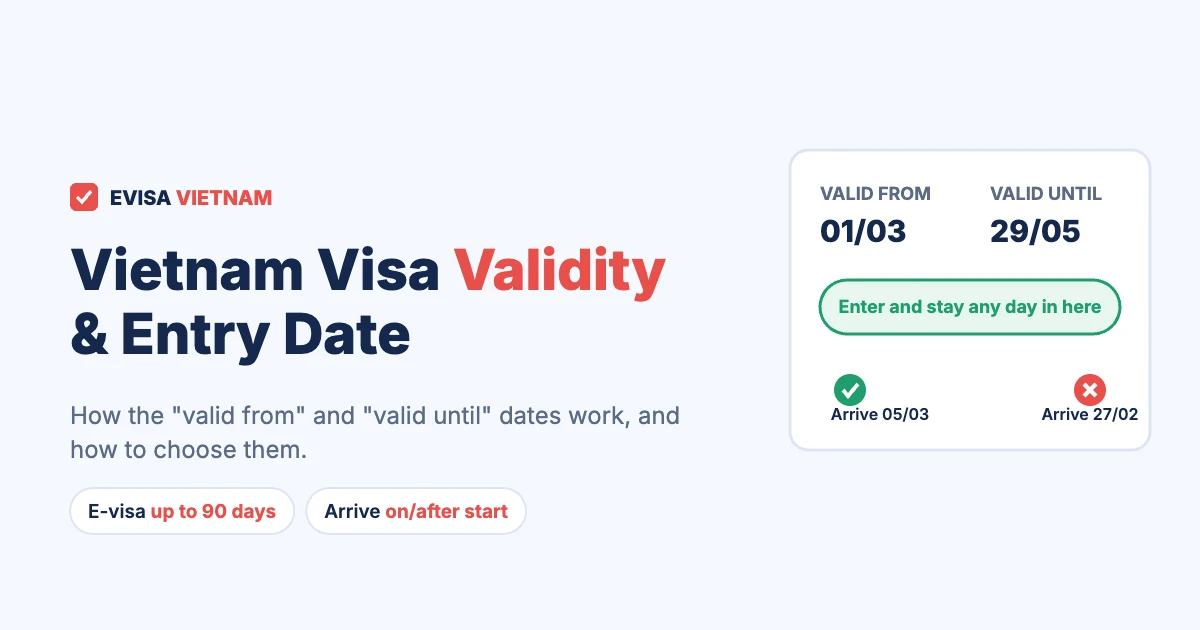
Vietnam visa validity is the period between two dates printed on your visa: “valid from” and “valid until”. You can enter Vietnam on the start date or any day after it, and you must leave by the end date. For the e-visa, you choose both dates when you apply, and the period can be up to 90 days. Arriving even one day before the start date can mean refusal at the airline counter or at immigration.
So you do not need to know your exact arrival day, but you do need to choose dates that safely cover your whole trip. This guide shows how the dates work, how to choose them, and what happens if your plans change.
Vietnam visa validity: key facts (November 2026)
- E-visa: up to 90 days, single entry (US$25) or multiple entry (US$50).
- Enter on or after the “valid from” date, never before.
- Leave on or before the “valid until” date.
- You pick the dates on the form, so add a small buffer.
- Visa exemption: the stay is counted from your entry day (for example, 45 days for UK citizens).
How Vietnam visa validity works
Think of your visa as a window. Your whole stay must fit inside it. Below, the example e-visa runs from 1 March to 29 May, which is 90 days when you count both dates.
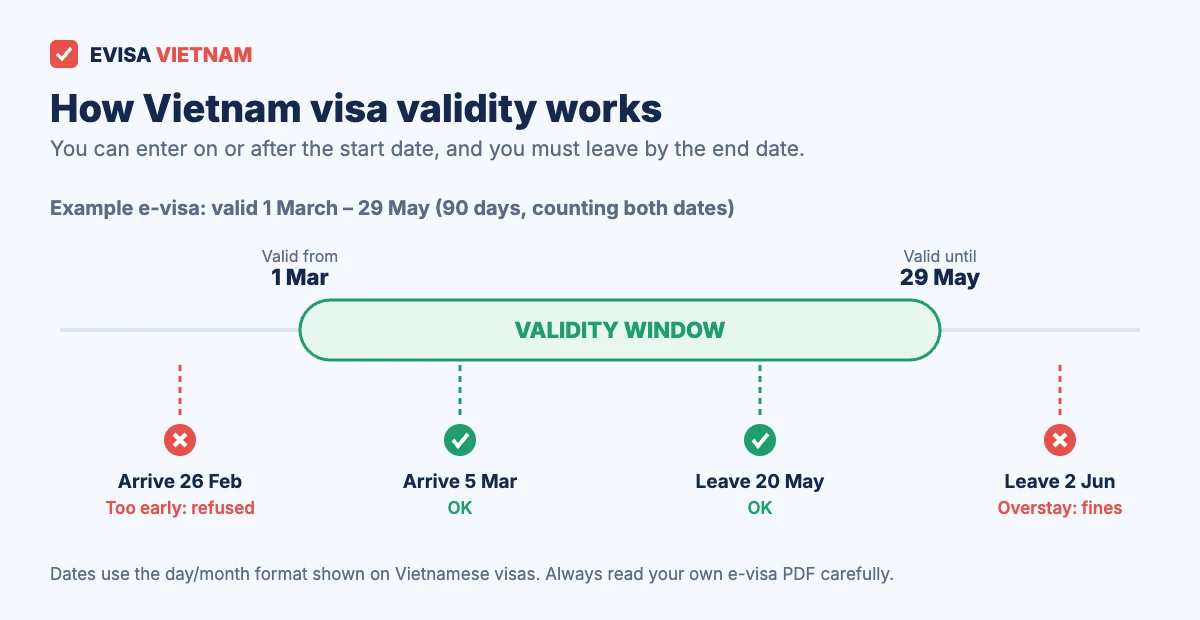
- Arrive on 26 February: too early. The airline may refuse boarding, and immigration will not accept the visa yet.
- Arrive on 5 March: fine. Arriving later than the start date is allowed.
- Leave on 20 May: fine. You can leave any time before the end date.
- Leave on 2 June: overstay. Fines apply, and future visits can become harder.
Note that a late arrival does not move the end date. In other words, if you arrive on 5 March, your visa still ends on 29 May.
How to choose your dates on the application
Because the dates are fixed once the visa is issued, choose them with care.
- Start date: use your planned arrival date, or one or two days earlier if your flight could change. A start date earlier than your arrival is harmless; a start date after your arrival is a problem.
- End date: add at least two or three days after your planned departure. Delays and missed connections happen.
- Length: stay within the 90-day maximum. For example, a 3-week trip from 10 to 31 July could use dates of 9 July to 3 August.
- Time zones: use the date you land in Vietnam, not the date you take off at home. Overnight flights often land a day later.
Also check that your passport is valid for at least six months after you arrive. Otherwise, the airline may stop you even with a correct visa.
Single entry or multiple entry?
Validity and entries are different things. Validity is how long the visa lasts; entries are how many times you can come in during that time.
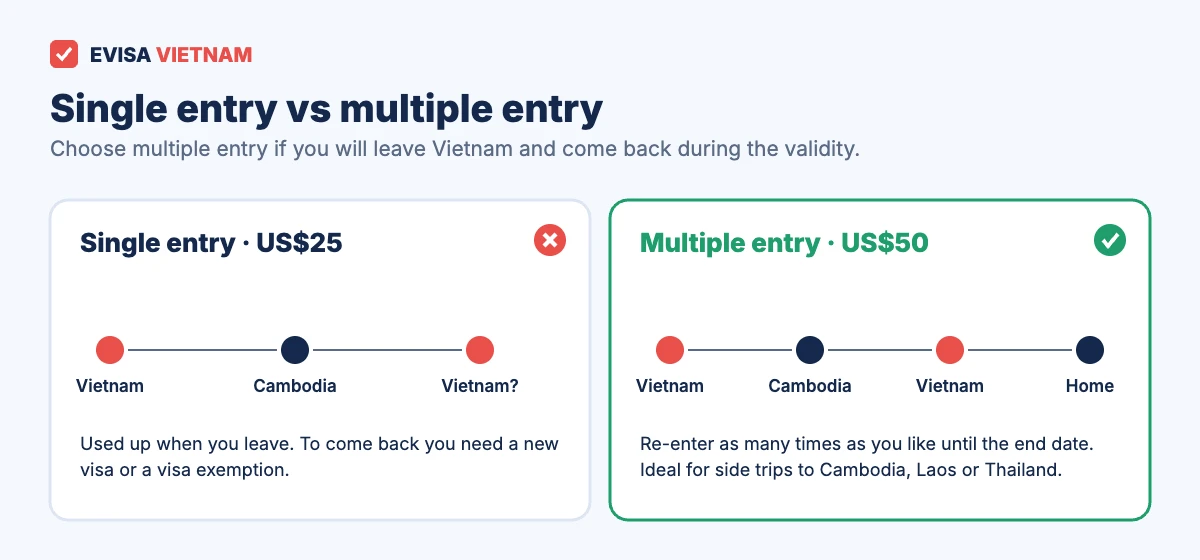
For instance, if you fly into Hanoi, take a bus to Laos and then return to Vietnam, you need multiple entry. A single-entry visa ends as soon as you leave, even if days are left on it. Compare all prices in our Vietnam visa cost guide.
Vietnam visa validity for visa on arrival and visa exemption
With visa on arrival, the approval letter lists your entry date and the visa length. Therefore, plan your flight to match that letter, and tell your agency before departure if your flight moves.
With a visa exemption, there is no start date. Instead, your stay is counted from the day you enter. For example, a German citizen arriving on 1 June can stay up to 45 days. Check your country in our list of countries exempted from Vietnam visa.
What if your plans change after you get the visa?
- You arrive later than planned: no action needed, as long as you still leave before the end date.
- You need to arrive earlier: the visa will not work before its start date, so you need a new visa with new dates.
- You want to stay longer: a tourist e-visa generally cannot be extended inside Vietnam. Plan the full stay, up to 90 days, at the start.
- You found a mistake in the dates: contact the service you used straight away, or apply again on the official portal.
Overstaying your Vietnam visa
Staying past the end date is an administrative violation. As a result, you pay a fine at the airport or at an immigration office before you can leave, and the amount grows with the length of the overstay. Serious cases can also lead to entry bans. If you see that you will overstay, contact the immigration office or a licensed service before the visa ends.
Worked example: a two-country trip
Leo, an Australian, lands in Ho Chi Minh City on 3 November, crosses into Cambodia on 15 November and comes back to Vietnam on 22 November. He flies home on 8 December. Because he enters Vietnam twice, he chooses a multiple-entry e-visa from 2 November to 11 December. That window covers both entries, it gives three spare days at the end, and it stays well under 90 days.
FAQ: Vietnam visa validity
Do I need to give the exact date of arrival?
No. You give a start date, and you can arrive on that day or later. Just never arrive before it.
Does Vietnam visa validity start on the day I land?
No. It starts on the “valid from” date printed on the visa, whatever day you actually arrive.
Is the 90-day e-visa counted in calendar days?
Yes. Count every day, including weekends, from the start date to the end date.
Can I enter on the last day of validity?
Technically yes, but you would have to leave the same day. In practice, enter well before the end date.
Where do I check my dates?
On the e-visa PDF you download from evisa.gov.vn. Our full Vietnam e-visa guide explains the rest of the document.
Sources: Vietnam National E-Visa Portal (evisa.gov.vn); Vietnam Immigration Department; Government Resolutions 44/NQ-CP and 229/NQ-CP on visa exemption. Last reviewed: 9 November 2026. We are an independent visa service, not a government website.