Do you need a Vietnam transit visa to change planes in Hanoi or Ho Chi Minh City? Not if you stay in the airport’s international transit area until your next flight. Vietnam’s immigration law exempts air transit passengers from a visa as long as they remain airside. The moment your connection takes you through immigration, such as to collect a bag, catch a domestic flight or visit the city, you are entering Vietnam and need a visa or a visa-free entitlement.
Vietnam transit visa: the short answer (November 2026)
- Staying airside between two international flights: no visa (Article 25 of the immigration law).
- You need a passport, an onward ticket to a third country and, if required, a visa for that country (Article 23).
- Collecting bags, a domestic leg or a trip into town means entering Vietnam: you need an e-visa, a visa or visa-free entry.
- Airside transit passengers do not file the digital arrival card.
When you need a Vietnam transit visa, and when you do not
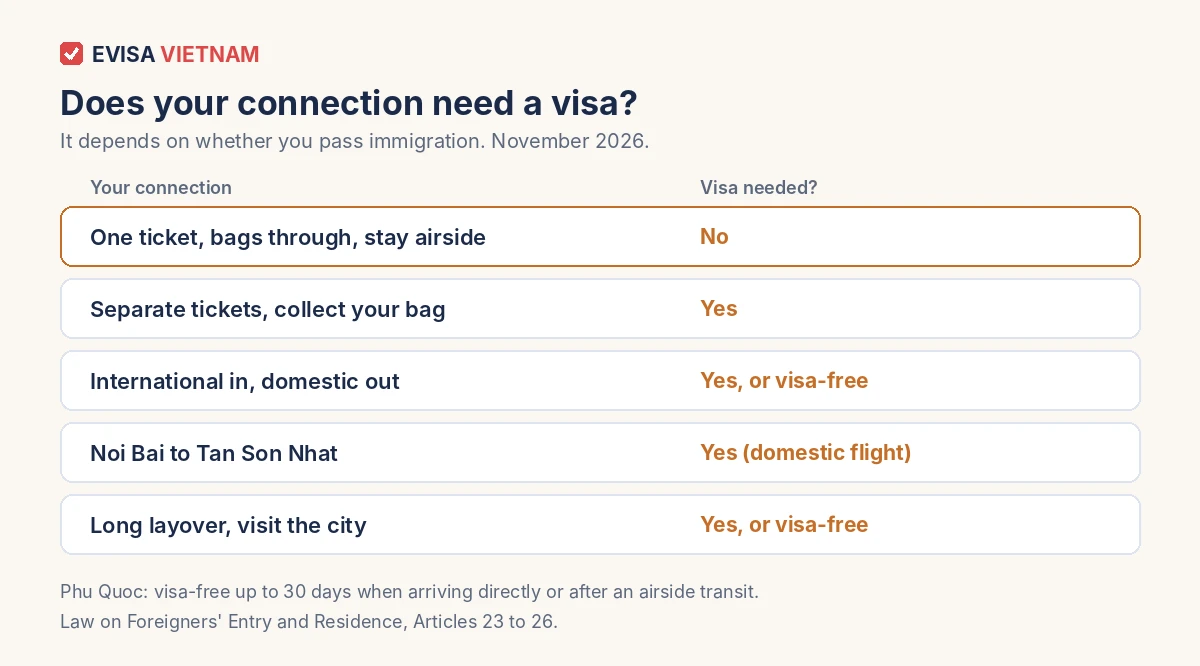
| Your connection | Visa needed? |
|---|---|
| International to international at the same airport, bags checked through, you stay in the transit area | No |
| Two separate tickets, so you must collect your bag and check in again | Yes: collecting a bag means passing immigration |
| International flight in, domestic flight out, such as Hanoi to Da Nang | Yes, or visa-free entry if your passport qualifies (Phu Quoc has its own rule, below) |
| Connection between Noi Bai (Hanoi) and Tan Son Nhat (Ho Chi Minh City) | Yes: the flight between them is domestic |
| A long layover and you want to see the city | Yes: an e-visa, visa-free entry, or an airline transit programme |
Phu Quoc island works differently. Visitors of any nationality can stay there without a visa for up to 30 days if they fly in from abroad directly, or change planes in Hanoi or Ho Chi Minh City without leaving the transit area. Our visa requirements by nationality page explains the rest of the island’s rule.
Vietnam’s law defines transit as passing through, or waiting in, the transit area of an international gate in order to travel on to a third country. Flying back to the country you came from is not transit in this sense.
The three conditions for airside transit
- A valid passport or other international travel document.
- An onward ticket that matches a journey to a third country.
- A visa for that third country, unless you are exempt from it. Your airline checks this at your first departure.
Ask your airline before you book whether it can check your bag through to the final destination and issue your boarding passes at the first airport. If it cannot, plan as if you were entering Vietnam.
A long layover: three ways to leave the airport
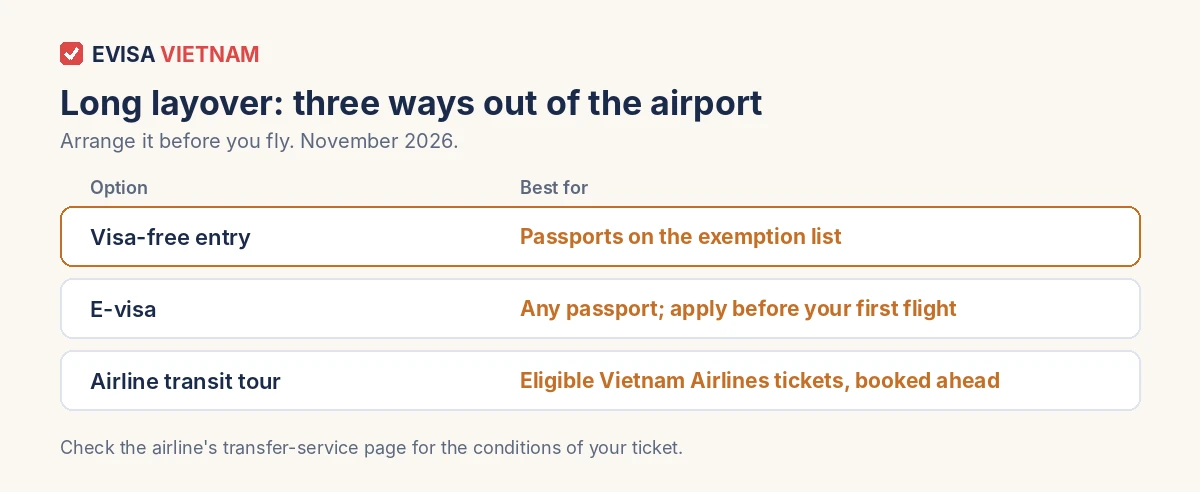
- Visa-free entry. If your passport is on Vietnam’s visa exemption list, you can pass immigration without a visa, within the number of days your passport allows.
- An e-visa. Apply before your first flight with an entry date that matches your arrival in Vietnam, and name the airport you will land at. Our standard service takes four working days; the cost guide shows prices and faster options.
- An airline transit programme. Vietnam Airlines offers transit tours and a transit visa service in Hanoi and Ho Chi Minh City for passengers on its international flights with long connections. The minimum connection times, routes and booking deadlines differ by the country where the ticket was issued and change during the year, so read the airline’s transfer-service page for your ticket and book well ahead.
The law also allows a visa to be considered for a transit passenger who wants to visit Vietnam during the transit time. In practice the e-visa is the simplest way to do this yourself.
Transit by sea
Cruise and ship passengers in transit are also exempt from a visa while they stay in the port’s transit area. A shore visit organised by an international tour operator in Vietnam can be granted a visa that matches the time in port. Ask your cruise line which option it uses.
Three connections, worked through
Bangkok to Sydney via Ho Chi Minh City
Nadia has one ticket, her bag goes through to Sydney and the layover is four hours. She stays in the transit area: no visa and no arrival card.
Two low-cost tickets via Hanoi
Tom booked Singapore to Hanoi and Hanoi to Tokyo separately. He must collect his bag in Hanoi and check in again, so he enters Vietnam. His passport is not visa-free, so he applies for an e-visa before the trip, with Hanoi as his entry airport.
A 12-hour layover in Hanoi
Leila has a long connection and wants to see the Old Quarter. She can apply for an e-visa, or check whether her Vietnam Airlines ticket qualifies for a transit tour. Either way she books before she flies.
FAQ: Vietnam transit visa
Is there a separate Vietnam transit visa?
For airside transit no visa is needed. If you leave the airport, you use a normal visa, an e-visa or visa-free entry, or the airline’s transit visa service where it applies.
How long can I stay in the transit area?
The law says you stay there while you wait for your flight. Check your airline’s own limits for long or overnight connections.
Can I transit and fly back to the country I came from?
That is not transit to a third country. Treat it as entering Vietnam and check whether you need a visa.
Do I need the digital arrival card in transit?
Not if you stay airside. If you pass immigration, see our digital arrival card guide.
We are an independent service, not a government website. Sources: Law on Entry, Exit, Transit and Residence of Foreigners in Vietnam No. 47/2014/QH13, as amended (Article 3 definition of transit; Articles 23–26 on transit conditions, transit areas, air and sea transit; official consolidated text); Vietnam Airlines, transfer and transit tour service (vietnamairlines.com). Last reviewed: 18 November 2026.