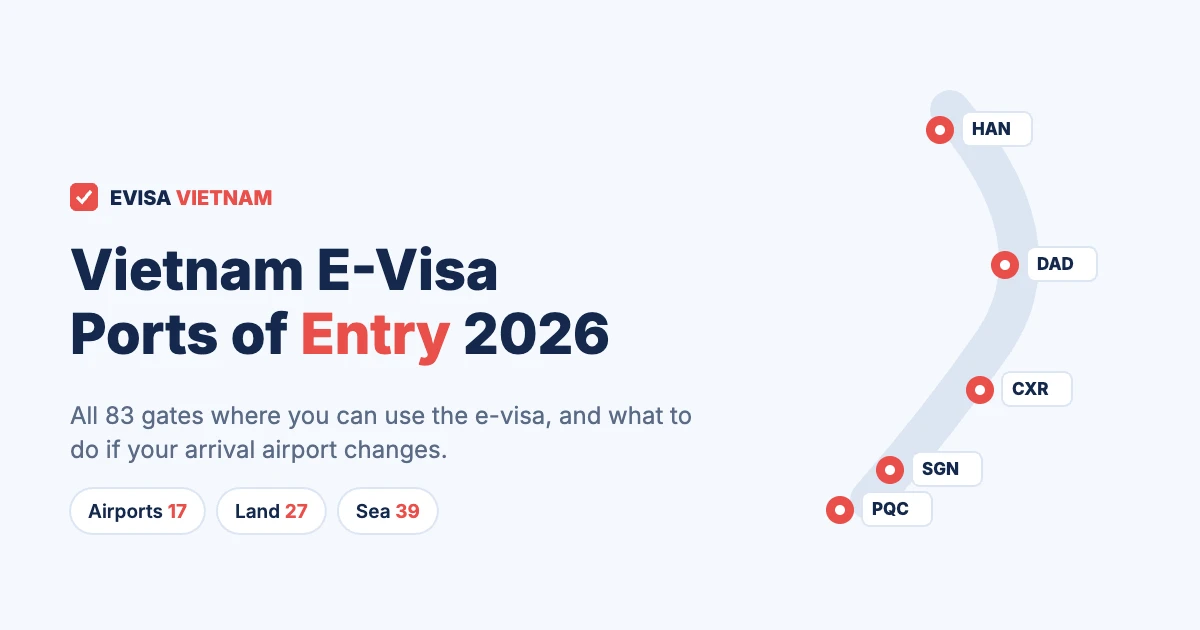
The Vietnam e-visa ports of entry are the 83 international border gates where you can enter or leave Vietnam with an e-visa: 17 airports, 27 land border gates and 39 seaports. The list grew from 42 gates to 83 after Resolution 389/NQ-CP of 2 December 2025. So if your flight changes from Hanoi to Ho Chi Minh City, or you decide to come overland from Cambodia, you are almost certainly still covered.
However, one question causes real confusion: can you enter through a different gate from the one you typed on your application? This guide answers it honestly, lists the airports and main land crossings, and explains what to do if you hold a visa on arrival letter instead.
Vietnam e-visa ports of entry: the facts (November 2026)
- 83 gates in total: 17 airports, 27 land gates and 39 seaports.
- Legal basis: Resolution 127/NQ-CP (August 2023, 42 gates) and Resolution 389/NQ-CP (December 2025, 41 more).
- New airports added in 2025: Vinh, Chu Lai, Long Thanh and Gia Binh (the last two once they open).
- Leaving through a different listed gate is widely accepted.
- Visa on arrival works at airports only, and the letter names one airport.
How many Vietnam e-visa ports of entry are there?
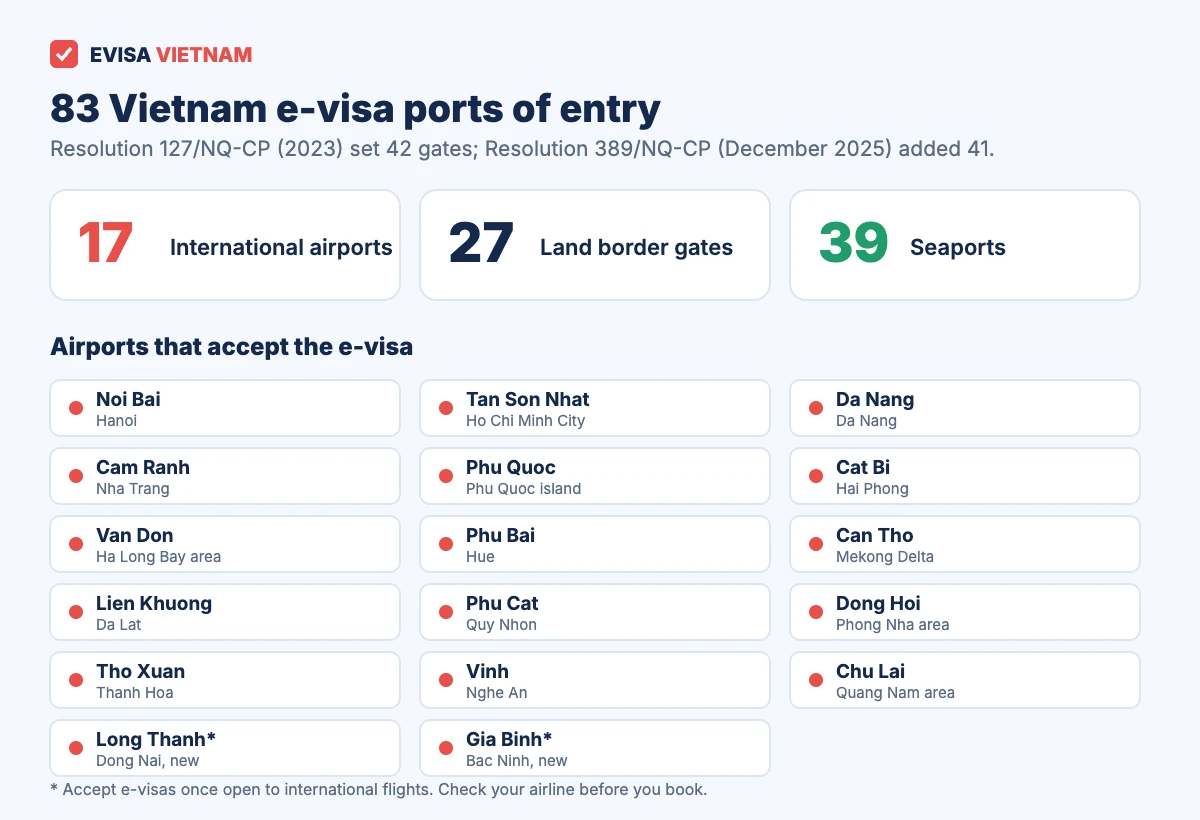
In August 2023, Vietnam opened the e-visa to every nationality and approved 42 gates: 13 airports, 16 land gates and 13 seaports. Then, in December 2025, the government added 41 more: 4 airports, 11 land gates and 26 seaports. As a result, the total is now 83.
Airports that accept the Vietnam e-visa
Most travelers arrive by air, so the airport list matters most. These are the 17 airports on the official list:
| Region | Airports |
|---|---|
| North | Noi Bai (Hanoi), Cat Bi (Hai Phong), Van Don (Quang Ninh), Tho Xuan (Thanh Hoa), Vinh (Nghe An), Gia Binh (Bac Ninh, once open) |
| Centre | Da Nang, Phu Bai (Hue), Dong Hoi, Chu Lai, Phu Cat (Quy Nhon), Cam Ranh (Nha Trang), Lien Khuong (Da Lat) |
| South | Tan Son Nhat (Ho Chi Minh City), Long Thanh (Dong Nai, once open), Can Tho, Phu Quoc |
Long Thanh, the new airport for Ho Chi Minh City, accepts e-visas as soon as it starts international operations. Until then, check with your airline which airport your flight really uses.
Land border gates and seaports
Unlike visa on arrival, the e-visa also works overland and by sea. For example, popular land crossings on the list include:
- With China: Huu Nghi, Mong Cai and Lao Cai, plus the Dong Dang and Lao Cai railway gates added in 2025.
- With Laos: Lao Bao, Cau Treo, Tay Trang, Nam Can, Cha Lo and Bo Y.
- With Cambodia: Moc Bai, Xa Mat, Tinh Bien and Ha Tien, plus newer gates such as Tan Nam, Thuong Phuoc and Dinh Ba.
Seaports include Hai Phong, Hon Gai (Ha Long), Chan May, Da Nang, Quy Nhon, Nha Trang, Vung Tau, Ho Chi Minh City and Duong Dong on Phu Quoc. Cruise terminals sometimes use a different name from the port on the list, so check the port name with your cruise line before you apply.
Can you enter through a different port from the one on your application?
This is where sources disagree, so here is what we know. The e-visa form asks for your intended entry and exit gates. Some services report that e-visas issued since late 2025 no longer print a specific gate, and that holders entered through other listed gates without trouble. Other services still advise that you must enter where you said. We have not seen an official notice that settles the question for every case.
Therefore, our advice is practical:
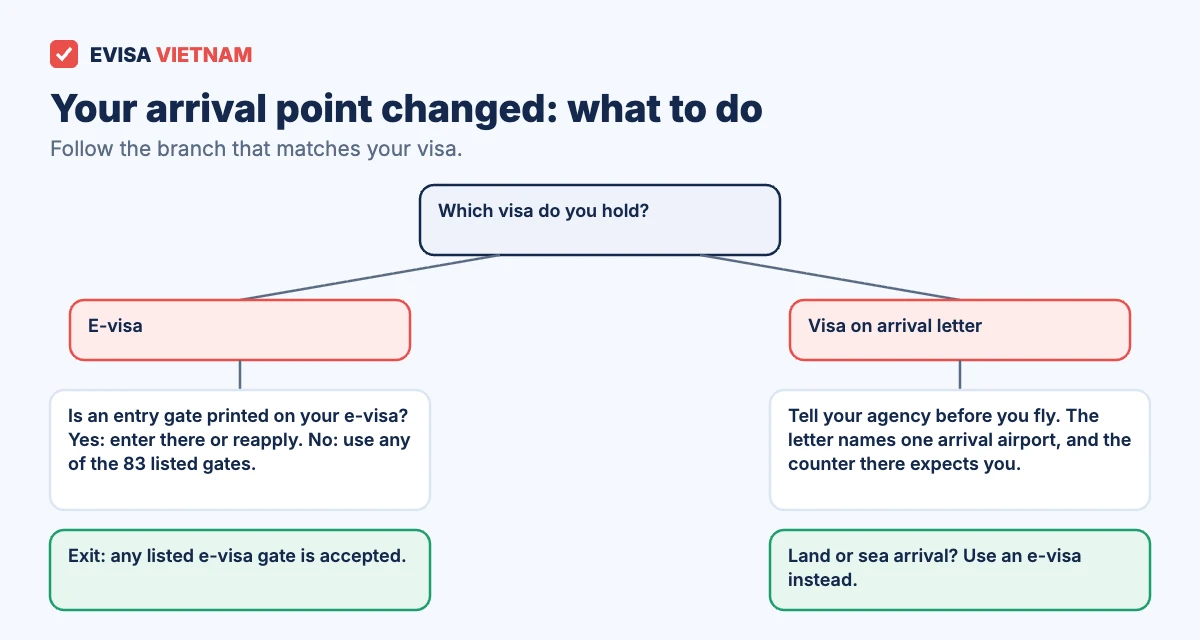
- Open your e-visa PDF. If it shows a specific entry gate, enter there. If your plans have changed a lot, consider a new application.
- If no gate is printed, use any of the 83 Vietnam e-visa ports of entry.
- For leaving, any gate on the list is generally accepted.
- When in doubt, ask the service that handled your visa before you travel.
What if you hold a visa on arrival approval letter?
A visa approval letter names your arrival airport, and the landing visa counter at that airport expects you. So if your flight moves to another airport, tell your agency before you fly. Also remember that visa on arrival never works at land borders or seaports. For those, you need an e-visa or a visa exemption. Our guide to visa on arrival compares the two options.
Worked examples
- Flight rerouted from Hanoi to Da Nang: Da Nang is on the list. If your e-visa shows Noi Bai as the entry gate, ask your service before departure; if no gate is shown, you can enter at Da Nang.
- Bus from Phnom Penh to Ho Chi Minh City: enter at Moc Bai with an e-visa. Visa on arrival will not work here.
- Fly into Hanoi, leave by train to China: exit through the Dong Dang or Lao Cai gate. Check the train route and your Chinese visa too.
- Cruise calling at Chan May and Nha Trang: choose multiple entry if the ship leaves Vietnam between ports, and match the port names with your cruise line.
Before you arrive: the Digital Arrival Card
Whichever gate you use, check whether it requires the free Digital Arrival Card. It started at Tan Son Nhat on 15 April 2026 and has since been extended to Phu Quoc, Noi Bai, Da Nang and Cam Ranh. You submit it within 72 hours before arrival at prearrival.immigration.gov.vn and show the QR code at passport control.
FAQ: Vietnam e-visa ports of entry
Can I change my flight and arrive at another airport in Vietnam?
Yes, if the new airport is one of the 17 on the list and your e-visa does not tie you to a specific gate. If it does, ask your visa service or reapply.
Can I enter Vietnam by land with an e-visa?
Yes, through any of the 27 listed land gates, such as Moc Bai or Lao Bao.
Can I leave from a different place than I entered?
Yes. Leaving through another listed gate is normal, for example entering at Hanoi and leaving at Ho Chi Minh City.
Where is the official list of e-visa gates?
On the official portal, evisa.gov.vn, and in Resolutions 127/NQ-CP and 389/NQ-CP. Our Vietnam e-visa guide covers the rest of the process.
How long does the e-visa take?
About 3 working days. See our guide to the Vietnam visa processing time.
Sources: Government Resolution 127/NQ-CP (14 August 2023); Government Resolution 389/NQ-CP (2 December 2025); Vietnam National E-Visa Portal; Vietnam Immigration Department notices on the Pre-arrival Information system. Last reviewed: 9 November 2026. We are an independent visa service, not a government website.