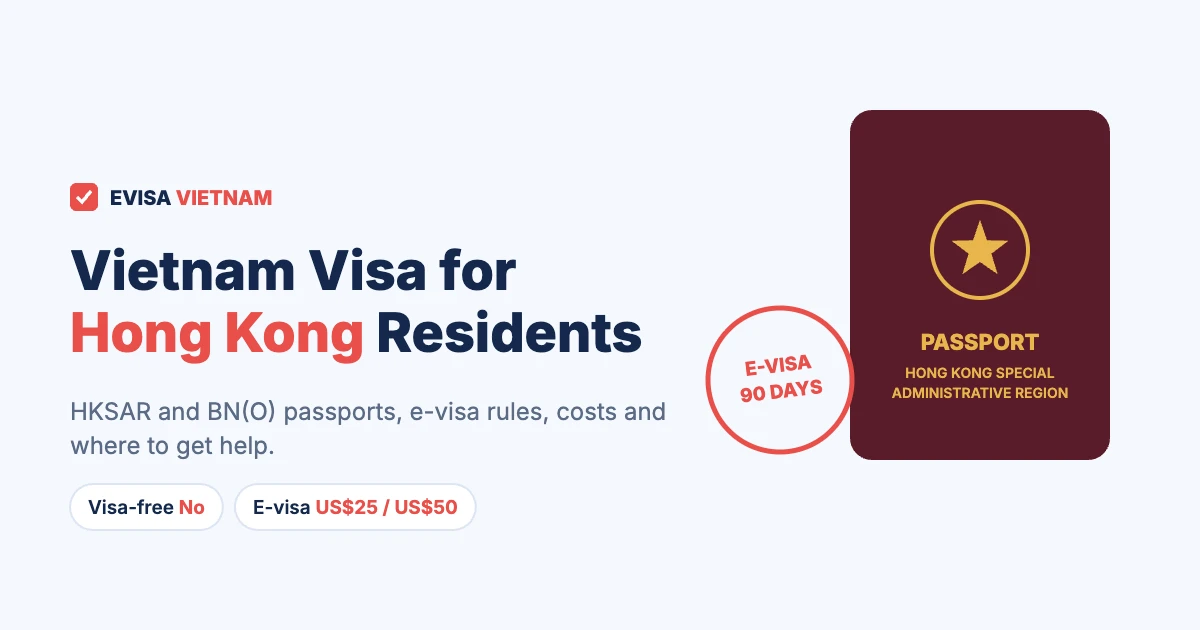
Yes, Hong Kong residents need a visa for mainland Vietnam. Holders of a Hong Kong SAR (HKSAR) passport are not on Vietnam’s visa-free list, so the easiest choice is the Vietnam visa for Hong Kong residents issued online: a 90-day e-visa costing US$25 for single entry or US$50 for multiple entry. However, the passport you travel on matters. Many Hongkongers also hold a British National (Overseas) passport, and that one causes problems, as explained below.
Flights from Hong Kong to Hanoi, Da Nang or Ho Chi Minh City take only about two hours, so short trips are common. This guide covers which passport to use, how to apply, timing around Hong Kong public holidays, and where to get help in Vietnam.
Vietnam visa for Hong Kong residents: quick facts (November 2026)
- HKSAR passport: visa needed. Use the 90-day e-visa, US$25 single / US$50 multiple entry.
- BN(O) passport: do not rely on it. The UK visa exemption is for British citizen passports.
- Vietnamese consulate in Hong Kong: Wan Chai.
- Help in Vietnam: Chinese missions and the Hong Kong Immigration 1868 hotline.
- Time difference: Hong Kong is 1 hour ahead of Vietnam.
Do Hong Kong residents need a visa for Vietnam?
Yes, for HKSAR passport holders. Vietnam’s exemptions cover a list of named countries, mostly European, plus Japan, South Korea and several ASEAN neighbours. Hong Kong SAR passports are not on that list, so you need a visa for the mainland. Check the latest list in our guide to who is exempted from Vietnam visa.
The exception is Phu Quoc island: any foreign visitor can stay there up to 30 days without a visa when flying in directly from abroad. Direct flights from Hong Kong to Phu Quoc therefore need no visa, as long as you stay on the island.
HKSAR or BN(O) passport: which one to use?
Many Hong Kong residents hold both an HKSAR passport and a BN(O) passport. It is tempting to assume the BN(O) gets the same 45-day exemption as a British passport. However, Vietnam’s exemption applies to citizens of the United Kingdom, and BN(O) status is not British citizenship. In addition, travel agencies report that e-visas issued on BN(O) passports have not been accepted consistently, and some travelers were refused at the border. Therefore, the safe choice is simple:
- Apply for the e-visa on your HKSAR passport and travel on that same passport.
- Do not mix passports. The passport number on your e-visa must match the passport you show at check-in and at immigration.
- If you hold a full British citizen passport, which is different from a BN(O), you can enter visa-free for 45 days on it.
How many Hong Kong visitors go to Vietnam?
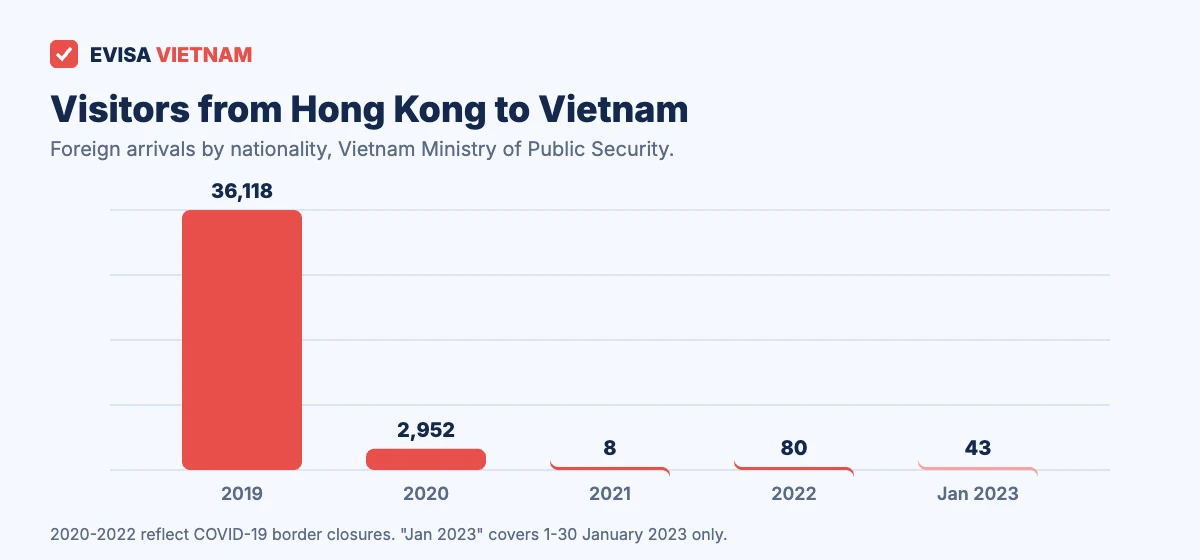
Vietnam’s Ministry of Public Security recorded 36,118 arrivals from Hong Kong in 2019. Then the numbers collapsed further than for almost any other market: only 8 in 2021 and 80 in 2022. This reflects Hong Kong’s own long quarantine rules for returning residents, which lasted until late 2022, more than Vietnam’s rules. Since then, short-haul trips have resumed.
Vietnam visa for Hong Kong residents: your options
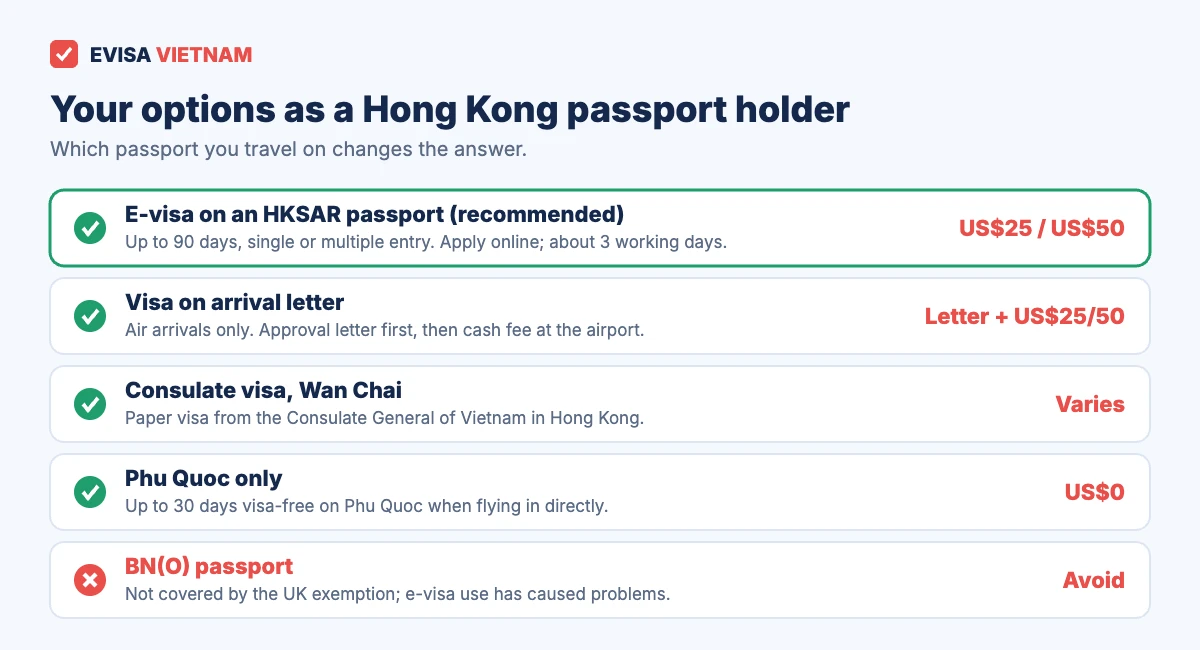
| Option | Length | Government fee | Best for |
|---|---|---|---|
| E-visa on HKSAR passport | Up to 90 days | US$25 / US$50 | Almost every trip |
| Visa on arrival (approval letter) | As stated on the letter | US$25 / US$50 cash + letter fee | Some urgent air arrivals |
| Visa from the consulate in Wan Chai | Depends on type | Set by the consulate | Special cases |
| Phu Quoc exemption | Up to 30 days | Free | Phu Quoc island only |
How to apply for a Vietnam visa as a Hong Kong resident
- Check your HKSAR passport. It must be valid for at least six months after arrival, with blank pages.
- Copy your name exactly as printed, using the same romanised spelling and order. For example, if the passport shows CHAN, TAI MAN, enter surname CHAN and given name TAI MAN.
- Prepare a 4×6 cm portrait on a white background with no glasses, plus a full scan of the data page. See our Vietnam visa photo guide.
- Apply on evisa.gov.vn or through a service. Our application form is also available in traditional Chinese.
- Pay by credit card and keep your registration code.
- Print the e-visa and check that the passport number matches the HKSAR passport you will carry.
When to apply: public holidays and Tet
Hong Kong residents often travel to Vietnam over Lunar New Year, Easter, the Chung Yeung and Christmas holidays. Lunar New Year is also Tet, when the Vietnam Immigration Department pauses processing for about a week; in 2026, e-visas were not processed from 14 to 22 February, and Tet 2027 starts on 6 February. As Vietnam is only one hour behind, a form sent during a Hong Kong working day usually reaches Vietnam within its office hours. Even so, apply at least two weeks ahead. See our Vietnam visa processing time guide.
How much does a Vietnam visa for Hong Kong residents cost?
The government fee is US$25 for single entry and US$50 for multiple entry, the same for every nationality. Your card issuer will convert from Hong Kong dollars and may add a small fee. With a service, the exact total for an HKSAR passport appears before payment. Compare all options in our Vietnam visa cost guide.
Where to get a visa and help
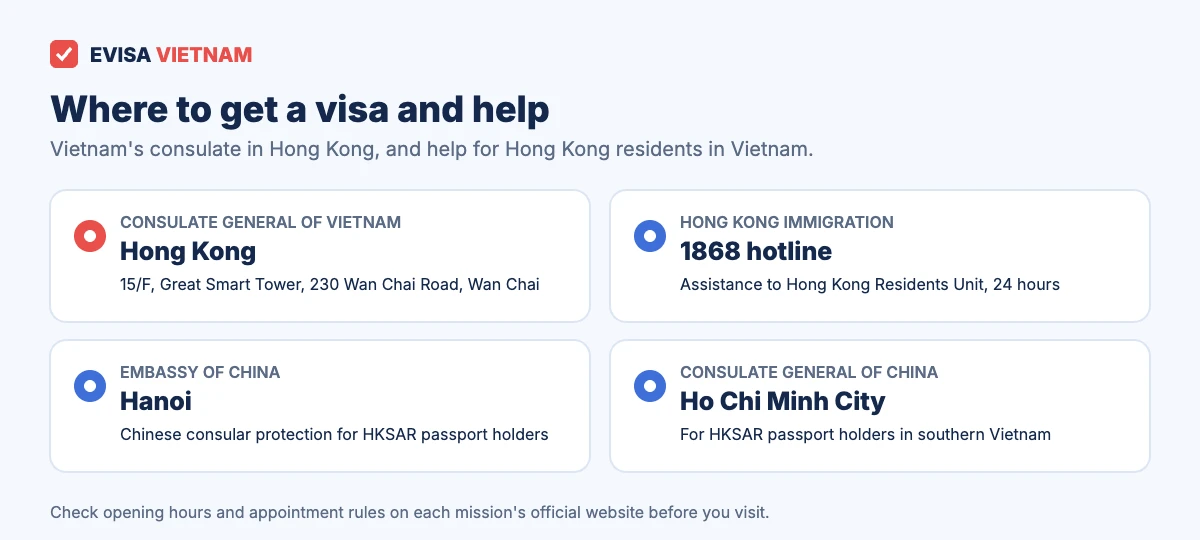
- Consulate General of Vietnam, Hong Kong: 15/F, Great Smart Tower, 230 Wan Chai Road, Wan Chai. It issues paper visas, but you do not need to visit it for an e-visa.
- Help in Vietnam: HKSAR passport holders receive consular protection from the Chinese Embassy in Hanoi and the Chinese Consulate General in Ho Chi Minh City.
- Hong Kong Immigration Department: its Assistance to Hong Kong Residents Unit runs a 24-hour hotline, (852) 1868, for residents in trouble abroad.
Macau residents
Macau SAR passport holders also need a visa for mainland Vietnam and can use the same 90-day e-visa. The steps and fees are identical, but apply on your Macau passport and travel with it.
Worked examples
- A long weekend in Da Nang over Easter: two friends each apply for a single-entry e-visa on their HKSAR passports three weeks before, 2 × US$25 = US$50.
- A traveler with HKSAR and BN(O) passports: applies and flies on the HKSAR passport only, and leaves the BN(O) at home or keeps it out of the process.
- A family flying direct to Phu Quoc for 5 nights: no visa needed, as long as they stay on the island.
FAQ: Vietnam visa for Hong Kong residents
Can I use my BN(O) passport to enter Vietnam visa-free?
No. The 45-day exemption is for British citizens. Use your HKSAR passport with an e-visa instead.
Can Hong Kong residents get a visa on arrival?
Only with an approval letter arranged before the flight, and only at international airports. See our guide to Vietnam visa on arrival.
How long can I stay?
Up to 90 days with an e-visa.
Do I need the Digital Arrival Card?
If you land in Ho Chi Minh City, Hanoi, Da Nang, Phu Quoc or Cam Ranh, submit the free card within 72 hours before arrival.
Sources: Vietnam National E-Visa Portal (evisa.gov.vn); Government Resolutions 44/NQ-CP and 229/NQ-CP on visa exemption; Vietnam Ministry of Public Security arrivals by nationality; Hong Kong Immigration Department. Last reviewed: 9 November 2026. We are an independent visa service, not a government website.