Vietnam visa on arrival in 2026: the two-stage process, costs, airports, documents and a clear comparison with the 90-day e-visa.

FAST AND EASY
Apply for a visa online in just a couple of minutes
Most e-visas are processed in about 3 working days
Apply for a visa online through our website. We check your form and photos before submission, follow up with the Vietnam Immigration Department and email you the result. Most e-visas take about 3 working days. Faster handling is available for urgent trips if you need a visa urgently.
APPLY NOW SEE HOW IT WORKS
APPLY NOW SEE HOW IT WORKS
Benefits from us
Clear pricing
You see the exact total for your nationality before you pay, government fee included. For example, a 30-day single-entry e-visa for a US passport costs US$60.
Hassle-free
No embassy visit needed. We review your details and photos before submission, so typos and photo problems are caught early.
Fair refund policy
Full refund if Vietnam Immigration rejects your application, the result does not match your details, or it arrives after your flight. See our refund policy.
Our pricing
for citizens of {{country.name}} change country?
Visa on arrival
E-Visa
Tourist visa
Business visa
First time traveler?
Here are all the things you need to know
Vietnam Evisa 2026: Complete Guide to the 90-Day E-Visa
Everything about the Vietnam evisa in 2026: eligibility, documents, photo rules, step-by-step application, processing time, fees and the 83 e-visa entry points.
Vietnam Visa Approval Letter 2026: What It Is, Cost & How to Use It
The Vietnam visa approval letter explained for 2026: who issues it, who still needs it, cost, processing time, airport checklist and how it compares with the e-visa.
NA1 Form & Visa on Arrival Documents: Vietnam Airport Guide 2026
The complete 2026 checklist for Vietnam visa on arrival: NA1 form explained, photos, stamping fee, approval letter, and where to pick up your visa at the airport.
Frequently Asked Questions
Who Is Exempted From Vietnam Visa? 2026 Visa-Free Countries List
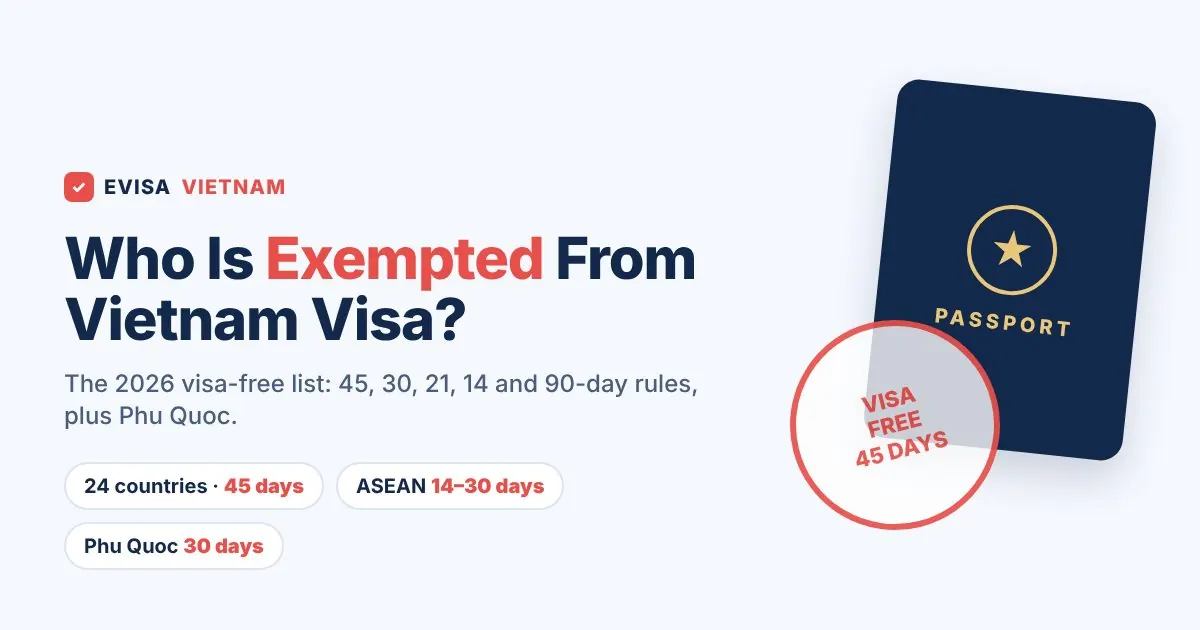
Citizens of more than 35 countries are exempted from Vietnam visa for short stays. The length depends on your passport: 90 days for Chile and Panama, 45 days for 24 countries including the UK, Germany, France, Japan and South Korea, and 14 to 30 days for most ASEAN neighbours. In addition, any foreigner can visit Phu Quoc island visa-free for up to 30 days.
This page gives the full 2026 list, the rules that apply to visa-free entry, and what to do when your trip is longer than your visa-free limit.
Key points (updated November 2026)
- The 45-day list has grown to 24 countries after Resolution 229/NQ-CP added 12 European countries from 15 August 2025.
- Resolution 44/NQ-CP keeps the original 12 countries at 45 days until 14 March 2028.
- USA, Canada, Australia, India and China are not exempted from Vietnam visa. They need an e-visa.
- Need longer? Apply for a 90-day e-visa instead.
Full list: who is exempted from Vietnam visa in 2026
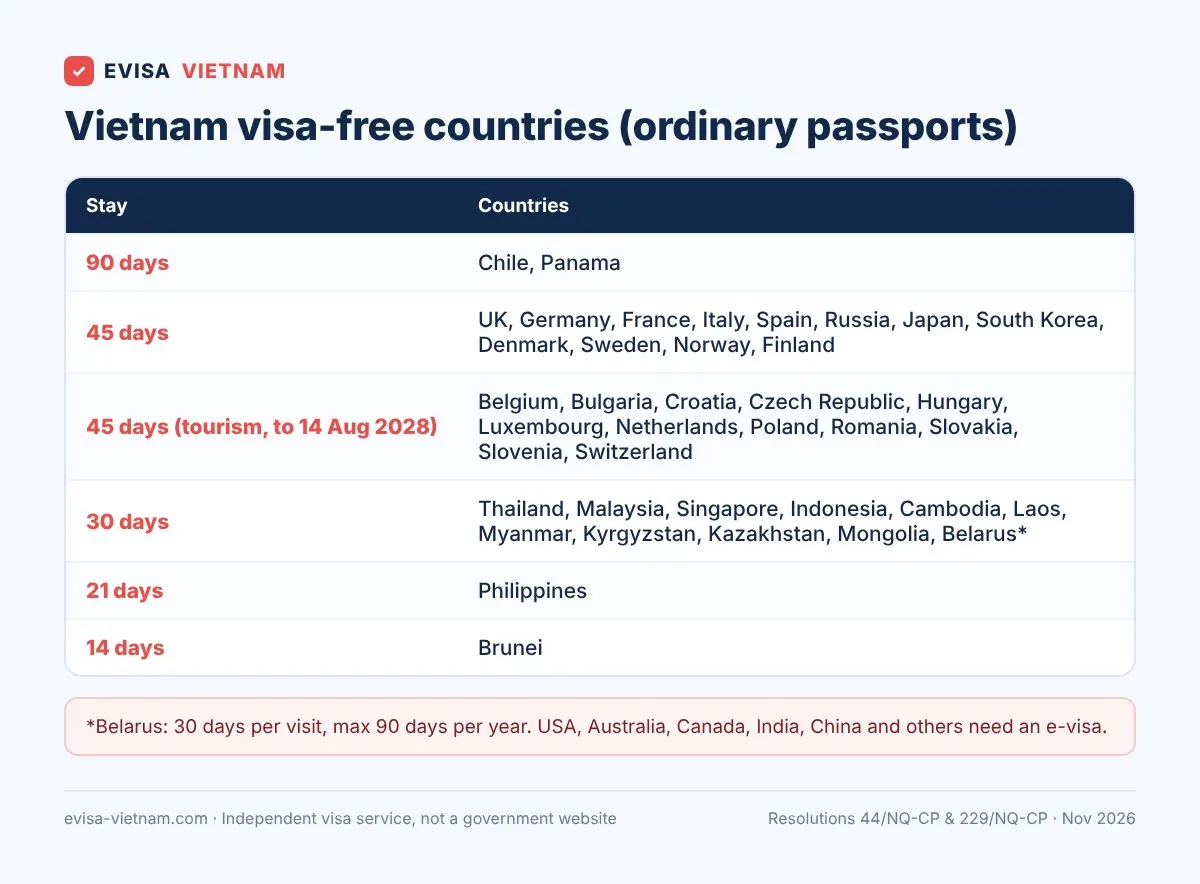
| Maximum stay | Countries (ordinary passports) | Basis |
|---|---|---|
| 90 days | Chile, Panama | Bilateral agreements |
| 45 days | United Kingdom, Germany, France, Italy, Spain, Russia, Japan, South Korea, Denmark, Sweden, Norway, Finland | Resolution 44/NQ-CP, until 14 March 2028 |
| 45 days | Belgium, Bulgaria, Croatia, Czech Republic, Hungary, Luxembourg, Netherlands, Poland, Romania, Slovakia, Slovenia, Switzerland | Resolution 229/NQ-CP, 15 August 2025 to 14 August 2028 |
| 30 days | Thailand, Malaysia, Singapore, Indonesia, Cambodia, Laos, Myanmar, Kyrgyzstan, Kazakhstan, Mongolia | Bilateral agreements |
| 30 days per visit (max 90 days per year) | Belarus | Bilateral agreement, from 30 January 2025 |
| 21 days | Philippines | ASEAN agreement |
| 14 days | Brunei | ASEAN agreement |
Note that the table covers ordinary passports. Holders of diplomatic or official passports follow separate agreements, so check with the nearest Vietnamese embassy.
Rules for travelers exempted from Vietnam visa
However, visa-free entry is not unconditional. At the border, officers may check that you meet the basic rules:
- Your passport is valid for at least six months from arrival.
- You have a return or onward ticket.
- You are not on any entry ban list.
- You have submitted the free Digital Arrival Card where it is required (introduced at Tan Son Nhat on 15 April 2026 and being extended to other gates).
Can I extend a visa-free stay?
In short, plan to leave before your limit ends. Visa-free stays are designed for short visits. If you want to stay longer, apply for an e-visa before you travel.
The 45-day group 2 is for tourism
The 12 countries added by Resolution 229/NQ-CP are exempted under a tourism promotion programme. If you travel for work, check whether a business visa is more suitable.
Phu Quoc: 30 days visa-free for everyone
In addition, Phu Quoc island has its own rule. Any foreign visitor can stay up to 30 days without a visa, provided they arrive on the island directly from abroad, or transit through Hanoi or Ho Chi Minh City airports without leaving the airport. If you want to visit the mainland as well, you need a visa or a visa exemption for Vietnam.
Not exempted from Vietnam visa? Use the e-visa
If your country is not on the list, or your stay is longer than your exemption, the Vietnam e-visa is the simplest solution. It lasts up to 90 days, costs US$25 for single entry or US$50 for multiple entry, and is open to every nationality. You can apply on the official portal, evisa.gov.vn.
| Visa exemption | E-visa | |
|---|---|---|
| Cost | Free | US$25 / US$50 |
| Length | 14–90 days by nationality | Up to 90 days |
| Re-entry | Depends on rules | Multiple entry option |
| Application | None | Online, about 3 working days |
Compare all options and prices in our Vietnam visa cost guide.
Examples
- British traveler, 3 weeks: exempted from Vietnam visa. No visa needed.
- British traveler, 2 months: longer than 45 days, so apply for a 90-day e-visa.
- American traveler, 1 week: not exempted. Apply for an e-visa.
- Thai traveler, 3 weeks: exempted for up to 30 days. No visa needed.
- Australian couple, 10 days on Phu Quoc only, arriving directly from abroad: visa-free on Phu Quoc.
FAQ: who is exempted from Vietnam visa
Are US citizens exempted from Vietnam visa?
No. Instead, US passport holders need a visa, usually the 90-day e-visa. See our guide to the Vietnam visa for US citizens.
Can I leave and come back visa-free many times?
Repeated back-to-back visa-free entries can attract questions at the border, and published guidance on waiting periods is not always consistent. If you plan to leave and re-enter Vietnam during one trip, a multiple-entry e-visa is the safer choice.
Do I need a visa if I only transit through Vietnam?
No, if you stay inside the international transit area of the airport and leave within 24 hours.
Are overseas Vietnamese exempted from Vietnam visa?
Vietnamese people living abroad, and their foreign spouses and children, can apply for a visa exemption certificate valid for up to five years.
Sources: Government Resolutions 44/NQ-CP (2025) and 229/NQ-CP (8 August 2025); bilateral visa exemption agreements; Vietnam–Belarus agreement effective 30 January 2025. Last reviewed: 9 November 2026. We are an independent visa service, not a government website.
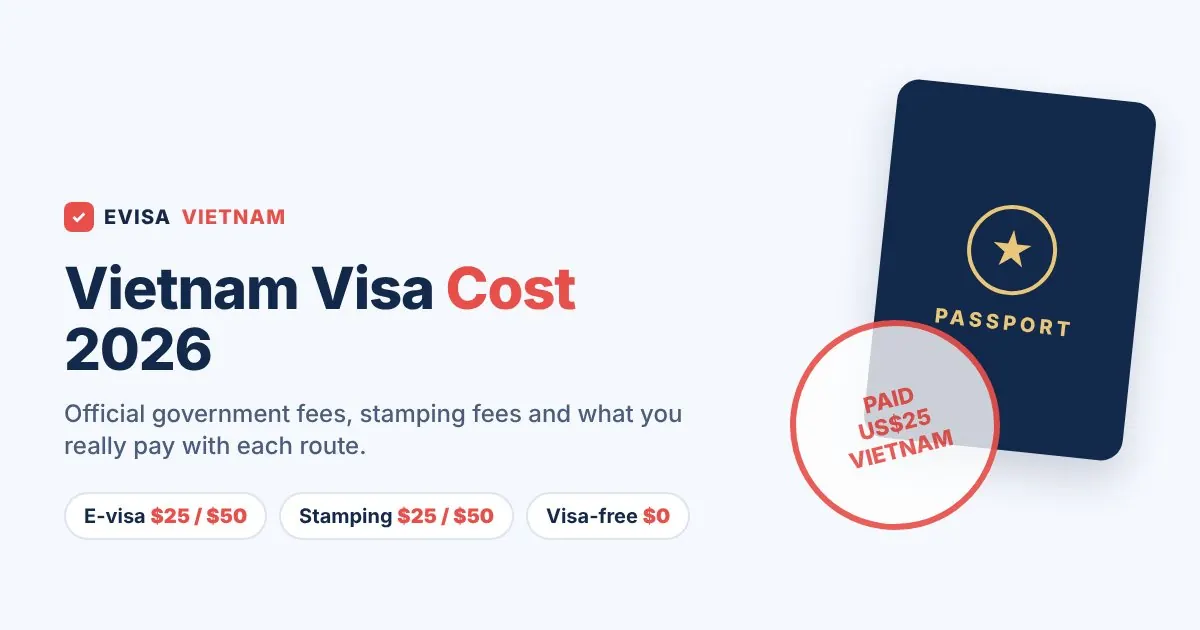
Vietnam Visa Cost 2026: Official Fees, Stamping Fee & What You Really Pay
Short answer: the official Vietnam visa cost is US$25 for a single-entry e-visa and US$50 for a multiple-entry e-visa, both valid for up to 90 days. If you use visa on arrival, you pay the same US$25 or US$50 in cash at the airport, plus a fee for the approval letter. And if your passport is on the visa-free list, your Vietnam visa cost is zero.
This guide breaks down every fee you can meet in 2026. It shows the government rates, the stamping fee, what agencies charge, and the hidden costs that catch travelers out. We also show our own prices next to the official fee, so you can decide whether you need help at all.
Key facts (updated November 2026)
- E-visa government fee: US$25 single entry, US$50 multiple entry, up to 90 days.
- Visa on arrival stamping fee: US$25 single, US$50 multiple, paid in cash at the airport.
- Legal basis: Circular 28/2026/TT-BTC, in force since 1 April 2026. It kept the previous rates.
- The fee is the same for every nationality.
- Government fees are not refunded if your application is refused.
Official Vietnam visa cost in 2026 (government fees)
Vietnam sets its visa fees by circular from the Ministry of Finance. The current schedule is Circular 28/2026/TT-BTC. It replaced the 2021 schedule on 1 April 2026, but the headline rates did not change. As a result, the US$25 and US$50 prices you may have seen before are still correct.
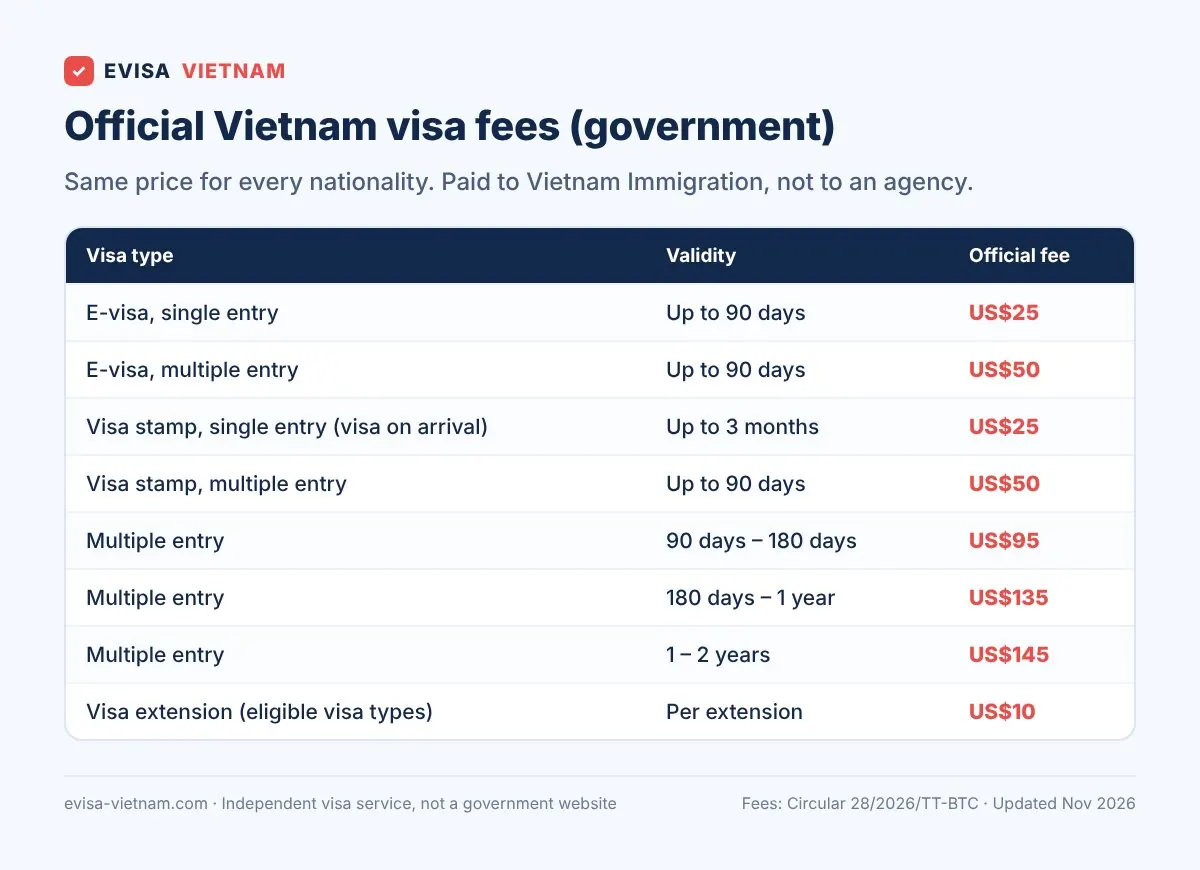
The table below lists the official fees. These amounts go to the Vietnam Immigration Department. They do not include any agency service fee.
| Visa type | Validity | Official fee |
|---|---|---|
| E-visa, single entry | Up to 90 days | US$25 |
| E-visa, multiple entry | Up to 90 days | US$50 |
| Visa stamp, single entry | Up to 3 months | US$25 |
| Visa stamp, multiple entry | Up to 90 days | US$50 |
| Multiple entry | Over 90 days, up to 180 days | US$95 |
| Multiple entry | Over 180 days, up to 1 year | US$135 |
| Multiple entry | Over 1 year, up to 2 years | US$145 |
| Visa extension (eligible visa types) | Per extension | US$10 |
Visas longer than 90 days need a sponsor in Vietnam, such as an employer or a family member. For that reason, most tourists only deal with the first two rows of the table.
Vietnam e-visa cost: US$25 or US$50
The e-visa is now the main route for tourists. It is open to citizens of every country and territory, and it lasts up to 90 days. You choose single entry or multiple entry when you apply.
- Single entry, US$25: you enter Vietnam once. When you leave, the visa is used up.
- Multiple entry, US$50: you can leave and come back within the validity. This suits trips that include Cambodia, Laos or Thailand.
You pay online by international card when you apply on the official portal, evisa.gov.vn. Results usually arrive in about three working days. There is no stamping fee on arrival for e-visa holders. However, the fee is not refunded if your e-visa is refused, so a small typo can cost you the full amount.
Read our full Vietnam e-visa guide for photo rules, entry points and the step-by-step process.
Visa on arrival cost: approval letter plus stamping fee
Visa on arrival is a two-part cost. First, a licensed agency obtains a visa approval letter for you. Then, at the airport, you pay the stamping fee in cash to the immigration officer.
- Approval letter: paid to the agency. Prices vary with speed and visa length.
- Stamping fee: US$25 for single entry or US$50 for multiple entry, cash only, US dollars recommended.
Because you pay twice, the total cost of visa on arrival is usually higher than an e-visa. In addition, it only works at international airports. That is why we now recommend it mainly for urgent trips. Learn how it works in our guides to the visa approval letter and visa on arrival in Vietnam.
Total Vietnam visa cost by route: a real comparison
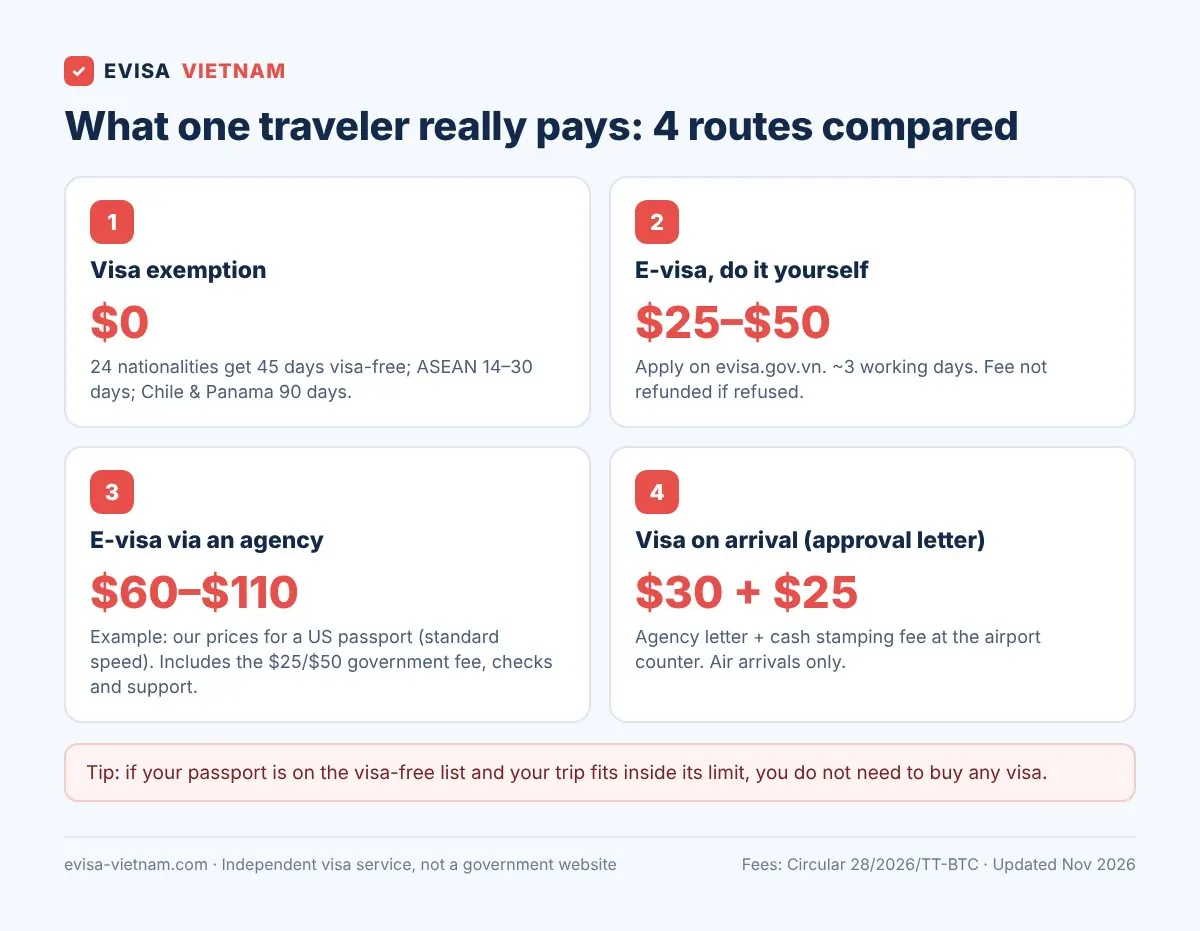
The government fee is only part of the story. The table below shows what one adult traveler really pays for each route.
| Route | What you pay | Typical total | Good for |
|---|---|---|---|
| Visa exemption | Nothing | US$0 | Eligible passports, short trips |
| E-visa, apply yourself | Government fee | US$25–50 | Confident travelers with time |
| E-visa through an agency | Government fee + service fee | About US$45–110 | Form checks, urgent cases, support |
| Visa on arrival | Letter fee + cash stamping fee | About US$45–80 | Urgent air arrivals |
Worked example: a family of four
Imagine two adults and two children from the United States. They plan a 14-day trip with one entry. US passports are not on the visa-free list, so everyone needs a visa, children included.
- E-visa yourself: 4 × US$25 = US$100.
- E-visa with our service (standard speed): 4 × US$60 = US$240, government fee included.
- Visa on arrival with our letter: 4 × (US$30 + US$25) = US$220, of which US$100 is paid in cash at the airport.
In short, if you have time and feel confident with the form, applying yourself is the cheapest option. On the other hand, a service makes sense when the trip is close, the form is complex, or a refusal would ruin expensive plans.
Our prices, shown openly
We are a private visa service, not a government website. You can always apply yourself at evisa.gov.vn for the official fee. If you prefer help, these are our current prices for a US passport, tourist purpose, standard processing. Each price already includes the government part of your Vietnam visa cost.
| Service | Our total price | Of which government fee |
|---|---|---|
| E-visa, 30 days, single entry | US$60 | US$25 |
| E-visa, 30 days, multiple entry | US$90 | US$50 |
| E-visa, 90 days, single entry | US$80 | US$25 |
| E-visa, 90 days, multiple entry | US$110 | US$50 |
| Visa on arrival letter, 15 days, single | US$30 + US$25 cash at airport | US$25 (at airport) |
Prices depend on nationality and processing speed, and the exact amount appears before you pay on our application form. Our fee covers a document check, submission, follow-up with you, and a refund under our refund policy if the visa is not granted for reasons outside your control.
Hidden costs most travelers forget
Beyond the visa itself, a few small costs can push your Vietnam visa cost up. Plan for them before you fly.
- Card fees: some banks add a foreign transaction fee when you pay the e-visa online.
- Cash for the stamp: visa on arrival counters take cash only. Bring clean US dollar notes in small values.
- Photos: visa on arrival needs a 4×6 cm photo. Bring your own to avoid delays at the counter.
- Mistakes: a wrong passport number or date can mean a new application and a second fee.
- Overstaying: staying past your visa leads to fines and possible problems on future trips.
Can you avoid the Vietnam visa cost completely?
Yes, in two common cases. First, citizens of 24 countries, including the UK, Germany, France, Japan and South Korea, can stay 45 days without a visa. Several ASEAN countries get 14 to 30 days. Second, any foreign visitor can stay on Phu Quoc island for up to 30 days without a visa when arriving there directly from abroad.
Check the full list in our guide: who is exempted from Vietnam visa.
Other costs to know before you enter Vietnam
Since 15 April 2026, most foreigners arriving at Tan Son Nhat airport must submit a Digital Arrival Card within 72 hours before landing, and the system is being extended to other entry points. It is free. You fill it in online and show the QR code at immigration. No agency fee is needed for it.
Frequently asked questions about Vietnam visa cost
How much is a Vietnam visa for US citizens?
The government fee is US$25 for a single-entry e-visa or US$50 for multiple entry. US citizens are not visa-exempt, so every traveler needs a visa. Read more in our guide to the Vietnam visa for US citizens.
Is the Vietnam visa fee different by nationality?
No. The official fee is the same for all nationalities. However, agency prices can differ, because some passports need more checks.
Do children pay the same visa fee?
Yes. Each traveler, including babies and children, needs their own visa and pays the same government fee.
Is the e-visa fee refundable?
No. The government does not refund the fee if your e-visa is refused or contains errors. Check every field before you pay.
Can I pay the stamping fee by card at the airport?
No. Visa on arrival counters accept cash only. US dollars are the safest choice.
Is a multiple-entry visa worth the extra US$25?
Only if you will leave and re-enter Vietnam during the trip. For a simple round trip, the single-entry visa is enough.
Sources: Circular 28/2026/TT-BTC fee schedule; the official e-visa portal evisa.gov.vn; Government Resolutions 44/NQ-CP and 229/NQ-CP on visa exemption. Last reviewed: 9 November 2026.
Vietnam E-Visa Ports of Entry 2026: 83 Gates & Changing Your Arrival Airport
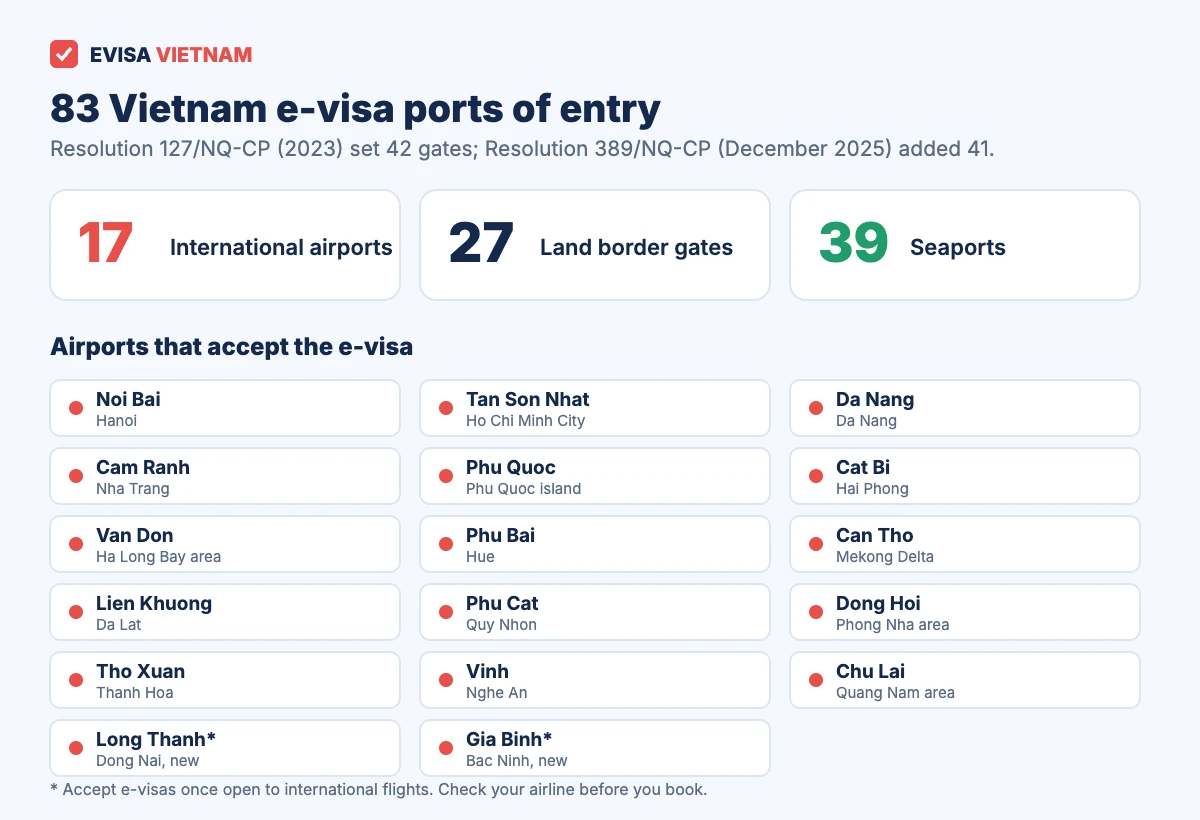
The Vietnam e-visa ports of entry are the 83 international border gates where you can enter or leave Vietnam with an e-visa: 17 airports, 27 land border gates and 39 seaports. The list grew from 42 gates to 83 after Resolution 389/NQ-CP of 2 December 2025. So if your flight changes from Hanoi to Ho Chi Minh City, or you decide to come overland from Cambodia, you are almost certainly still covered.
However, one question causes real confusion: can you enter through a different gate from the one you typed on your application? This guide answers it honestly, lists the airports and main land crossings, and explains what to do if you hold a visa on arrival letter instead.
Vietnam e-visa ports of entry: the facts (November 2026)
- 83 gates in total: 17 airports, 27 land gates and 39 seaports.
- Legal basis: Resolution 127/NQ-CP (August 2023, 42 gates) and Resolution 389/NQ-CP (December 2025, 41 more).
- New airports added in 2025: Vinh, Chu Lai, Long Thanh and Gia Binh (the last two once they open).
- Leaving through a different listed gate is widely accepted.
- Visa on arrival works at airports only, and the letter names one airport.
How many Vietnam e-visa ports of entry are there?
In August 2023, Vietnam opened the e-visa to every nationality and approved 42 gates: 13 airports, 16 land gates and 13 seaports. Then, in December 2025, the government added 41 more: 4 airports, 11 land gates and 26 seaports. As a result, the total is now 83.
Airports that accept the Vietnam e-visa
Most travelers arrive by air, so the airport list matters most. These are the 17 airports on the official list:
| Region | Airports |
|---|---|
| North | Noi Bai (Hanoi), Cat Bi (Hai Phong), Van Don (Quang Ninh), Tho Xuan (Thanh Hoa), Vinh (Nghe An), Gia Binh (Bac Ninh, once open) |
| Centre | Da Nang, Phu Bai (Hue), Dong Hoi, Chu Lai, Phu Cat (Quy Nhon), Cam Ranh (Nha Trang), Lien Khuong (Da Lat) |
| South | Tan Son Nhat (Ho Chi Minh City), Long Thanh (Dong Nai, once open), Can Tho, Phu Quoc |
Long Thanh, the new airport for Ho Chi Minh City, accepts e-visas as soon as it starts international operations. Until then, check with your airline which airport your flight really uses.
Land border gates and seaports
Unlike visa on arrival, the e-visa also works overland and by sea. For example, popular land crossings on the list include:
- With China: Huu Nghi, Mong Cai and Lao Cai, plus the Dong Dang and Lao Cai railway gates added in 2025.
- With Laos: Lao Bao, Cau Treo, Tay Trang, Nam Can, Cha Lo and Bo Y.
- With Cambodia: Moc Bai, Xa Mat, Tinh Bien and Ha Tien, plus newer gates such as Tan Nam, Thuong Phuoc and Dinh Ba.
Seaports include Hai Phong, Hon Gai (Ha Long), Chan May, Da Nang, Quy Nhon, Nha Trang, Vung Tau, Ho Chi Minh City and Duong Dong on Phu Quoc. Cruise terminals sometimes use a different name from the port on the list, so check the port name with your cruise line before you apply.
Can you enter through a different port from the one on your application?
This is where sources disagree, so here is what we know. The e-visa form asks for your intended entry and exit gates. Some services report that e-visas issued since late 2025 no longer print a specific gate, and that holders entered through other listed gates without trouble. Other services still advise that you must enter where you said. We have not seen an official notice that settles the question for every case.
Therefore, our advice is practical:
- Open your e-visa PDF. If it shows a specific entry gate, enter there. If your plans have changed a lot, consider a new application.
- If no gate is printed, use any of the 83 Vietnam e-visa ports of entry.
- For leaving, any gate on the list is generally accepted.
- When in doubt, ask the service that handled your visa before you travel.
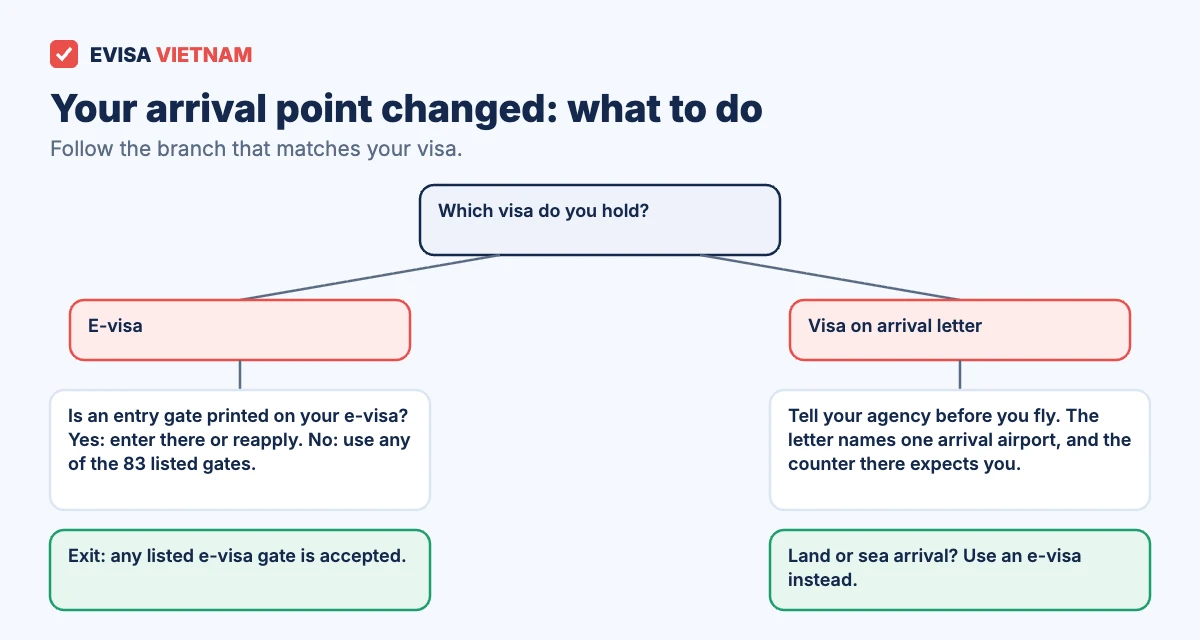
What if you hold a visa on arrival approval letter?
A visa approval letter names your arrival airport, and the landing visa counter at that airport expects you. So if your flight moves to another airport, tell your agency before you fly. Also remember that visa on arrival never works at land borders or seaports. For those, you need an e-visa or a visa exemption. Our guide to visa on arrival compares the two options.
Worked examples
- Flight rerouted from Hanoi to Da Nang: Da Nang is on the list. If your e-visa shows Noi Bai as the entry gate, ask your service before departure; if no gate is shown, you can enter at Da Nang.
- Bus from Phnom Penh to Ho Chi Minh City: enter at Moc Bai with an e-visa. Visa on arrival will not work here.
- Fly into Hanoi, leave by train to China: exit through the Dong Dang or Lao Cai gate. Check the train route and your Chinese visa too.
- Cruise calling at Chan May and Nha Trang: choose multiple entry if the ship leaves Vietnam between ports, and match the port names with your cruise line.
Before you arrive: the Digital Arrival Card
Whichever gate you use, check whether it requires the free Digital Arrival Card. It started at Tan Son Nhat on 15 April 2026 and has since been extended to Phu Quoc, Noi Bai, Da Nang and Cam Ranh. You submit it within 72 hours before arrival at prearrival.immigration.gov.vn and show the QR code at passport control.
FAQ: Vietnam e-visa ports of entry
Can I change my flight and arrive at another airport in Vietnam?
Yes, if the new airport is one of the 17 on the list and your e-visa does not tie you to a specific gate. If it does, ask your visa service or reapply.
Can I enter Vietnam by land with an e-visa?
Yes, through any of the 27 listed land gates, such as Moc Bai or Lao Bao.
Can I leave from a different place than I entered?
Yes. Leaving through another listed gate is normal, for example entering at Hanoi and leaving at Ho Chi Minh City.
Where is the official list of e-visa gates?
On the official portal, evisa.gov.vn, and in Resolutions 127/NQ-CP and 389/NQ-CP. Our Vietnam e-visa guide covers the rest of the process.
How long does the e-visa take?
About 3 working days. See our guide to the Vietnam visa processing time.
Sources: Government Resolution 127/NQ-CP (14 August 2023); Government Resolution 389/NQ-CP (2 December 2025); Vietnam National E-Visa Portal; Vietnam Immigration Department notices on the Pre-arrival Information system. Last reviewed: 9 November 2026. We are an independent visa service, not a government website.
Vietnam Visa Validity & Entry Date: How Your Visa Dates Work (2026)
Vietnam visa validity is the period between two dates printed on your visa: “valid from” and “valid until”. You can enter Vietnam on the start date or any day after it, and you must leave by the end date. For the e-visa, you choose both dates when you apply, and the period can be up to 90 days. Arriving even one day before the start date can mean refusal at the airline counter or at immigration.
So you do not need to know your exact arrival day, but you do need to choose dates that safely cover your whole trip. This guide shows how the dates work, how to choose them, and what happens if your plans change.
Vietnam visa validity: key facts (November 2026)
- E-visa: up to 90 days, single entry (US$25) or multiple entry (US$50).
- Enter on or after the “valid from” date, never before.
- Leave on or before the “valid until” date.
- You pick the dates on the form, so add a small buffer.
- Visa exemption: the stay is counted from your entry day (for example, 45 days for UK citizens).
How Vietnam visa validity works
Think of your visa as a window. Your whole stay must fit inside it. Below, the example e-visa runs from 1 March to 29 May, which is 90 days when you count both dates.
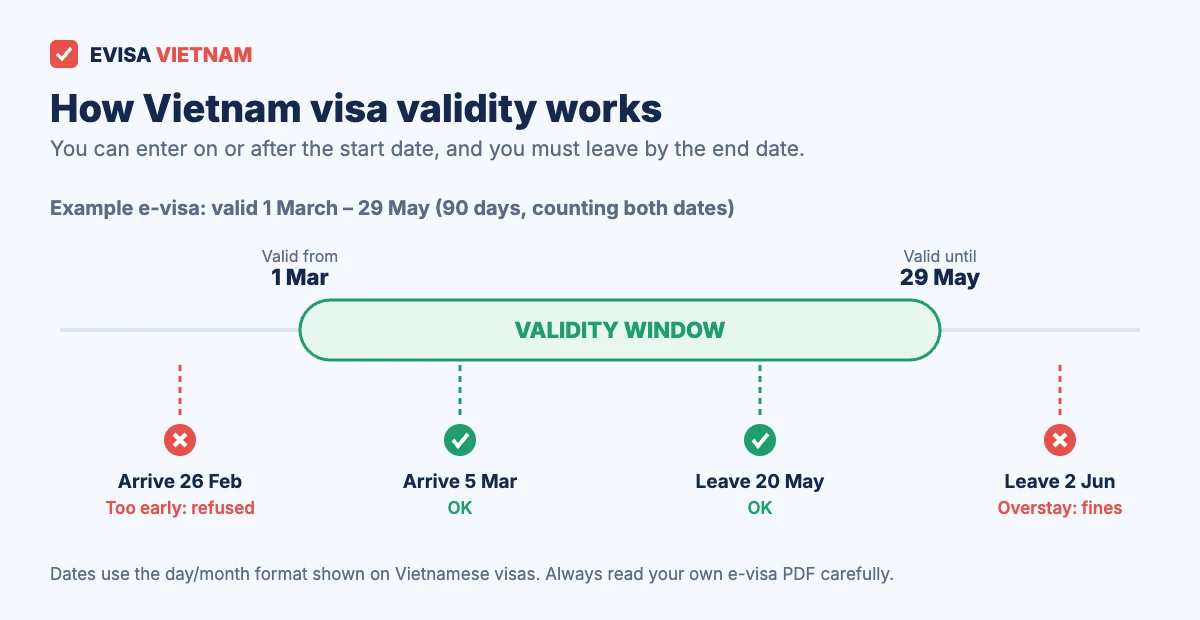
- Arrive on 26 February: too early. The airline may refuse boarding, and immigration will not accept the visa yet.
- Arrive on 5 March: fine. Arriving later than the start date is allowed.
- Leave on 20 May: fine. You can leave any time before the end date.
- Leave on 2 June: overstay. Fines apply, and future visits can become harder.
Note that a late arrival does not move the end date. In other words, if you arrive on 5 March, your visa still ends on 29 May.
How to choose your dates on the application
Because the dates are fixed once the visa is issued, choose them with care.
- Start date: use your planned arrival date, or one or two days earlier if your flight could change. A start date earlier than your arrival is harmless; a start date after your arrival is a problem.
- End date: add at least two or three days after your planned departure. Delays and missed connections happen.
- Length: stay within the 90-day maximum. For example, a 3-week trip from 10 to 31 July could use dates of 9 July to 3 August.
- Time zones: use the date you land in Vietnam, not the date you take off at home. Overnight flights often land a day later.
Also check that your passport is valid for at least six months after you arrive. Otherwise, the airline may stop you even with a correct visa.
Single entry or multiple entry?
Validity and entries are different things. Validity is how long the visa lasts; entries are how many times you can come in during that time.
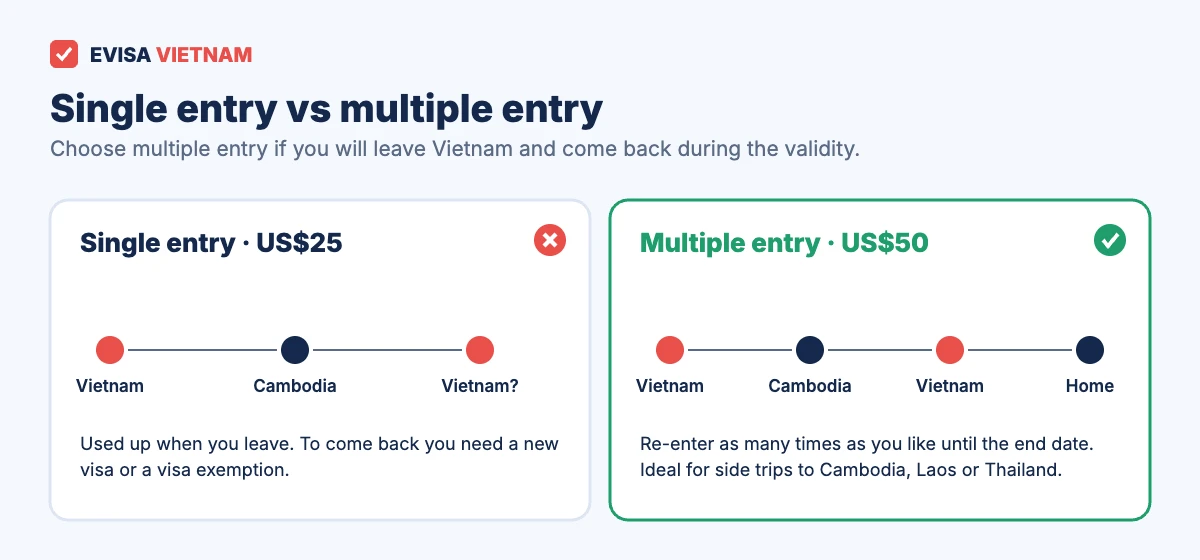
For instance, if you fly into Hanoi, take a bus to Laos and then return to Vietnam, you need multiple entry. A single-entry visa ends as soon as you leave, even if days are left on it. Compare all prices in our Vietnam visa cost guide.
Vietnam visa validity for visa on arrival and visa exemption
With visa on arrival, the approval letter lists your entry date and the visa length. Therefore, plan your flight to match that letter, and tell your agency before departure if your flight moves.
With a visa exemption, there is no start date. Instead, your stay is counted from the day you enter. For example, a German citizen arriving on 1 June can stay up to 45 days. Check your country in our list of countries exempted from Vietnam visa.
What if your plans change after you get the visa?
- You arrive later than planned: no action needed, as long as you still leave before the end date.
- You need to arrive earlier: the visa will not work before its start date, so you need a new visa with new dates.
- You want to stay longer: a tourist e-visa generally cannot be extended inside Vietnam. Plan the full stay, up to 90 days, at the start.
- You found a mistake in the dates: contact the service you used straight away, or apply again on the official portal.
Overstaying your Vietnam visa
Staying past the end date is an administrative violation. As a result, you pay a fine at the airport or at an immigration office before you can leave, and the amount grows with the length of the overstay. Serious cases can also lead to entry bans. If you see that you will overstay, contact the immigration office or a licensed service before the visa ends.
Worked example: a two-country trip
Leo, an Australian, lands in Ho Chi Minh City on 3 November, crosses into Cambodia on 15 November and comes back to Vietnam on 22 November. He flies home on 8 December. Because he enters Vietnam twice, he chooses a multiple-entry e-visa from 2 November to 11 December. That window covers both entries, it gives three spare days at the end, and it stays well under 90 days.
FAQ: Vietnam visa validity
Do I need to give the exact date of arrival?
No. You give a start date, and you can arrive on that day or later. Just never arrive before it.
Does Vietnam visa validity start on the day I land?
No. It starts on the “valid from” date printed on the visa, whatever day you actually arrive.
Is the 90-day e-visa counted in calendar days?
Yes. Count every day, including weekends, from the start date to the end date.
Can I enter on the last day of validity?
Technically yes, but you would have to leave the same day. In practice, enter well before the end date.
Where do I check my dates?
On the e-visa PDF you download from evisa.gov.vn. Our full Vietnam e-visa guide explains the rest of the document.
Sources: Vietnam National E-Visa Portal (evisa.gov.vn); Vietnam Immigration Department; Government Resolutions 44/NQ-CP and 229/NQ-CP on visa exemption. Last reviewed: 9 November 2026. We are an independent visa service, not a government website.
Vietnam Visa Photo Requirements 2026: Size, Rules & Examples
A Vietnam visa photo must be a recent colour portrait, 4×6 cm, on a plain white background. You look straight at the camera with your eyes open and your mouth closed, and you wear no glasses and no hat. For the e-visa, you upload this photo as a JPG file together with a separate image of your passport data page. For visa on arrival, by contrast, you bring printed photos to the airport.
Photo problems are one of the most common reasons why an e-visa is delayed or refused. So this guide shows the exact rules, a do-and-don’t chart, a simple way to take the photo at home, and what to do if Immigration asks for a new one.
Vietnam visa photo: key rules (checked November 2026)
- Size: 4×6 cm portrait (width × height), a 2:3 ratio.
- Background: plain white, no shadows or patterns.
- Pose: face the camera, eyes open, mouth closed, neutral expression.
- No glasses (including prescription glasses) and no hat.
- E-visa file: JPG. Keep it under 2 MB, which is the limit on the current upload form.
- Second upload: the full passport data page, including the two MRZ lines at the bottom.
Vietnam visa photo requirements at a glance
The rules are almost the same for every type of visa. However, the format changes: the e-visa needs a digital file, while visa on arrival and embassy visas need prints. The table below compares them.
| Requirement | E-visa (upload) | Visa on arrival / embassy (print) |
|---|---|---|
| Size | 4×6 cm portrait ratio | 4×6 cm prints |
| Number | 1 portrait file + 1 passport page image | Usually 2 identical photos |
| Background | Plain white | Plain white |
| File or paper | JPG, under 2 MB | Photo paper, glossy or matte |
| Age of photo | Recent (taken within 6 months is a safe rule) | Recent |
| Glasses and hat | Not allowed | Not allowed |
In short, if you prepare one good digital portrait, you can use it for the e-visa and also print it for visa on arrival.
Correct vs incorrect Vietnam visa photo
The e-visa system checks your portrait against the photo in your passport. As a result, anything that makes your face harder to compare can slow the application down.
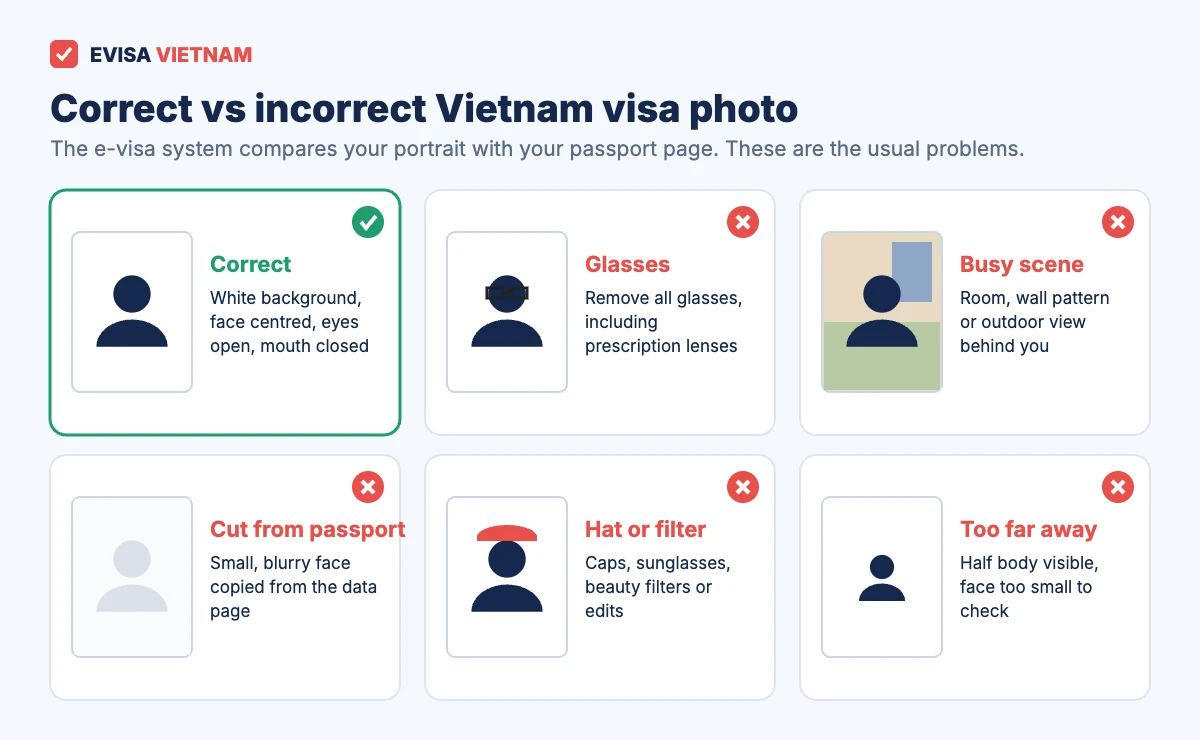
- Glasses: take them off, even if your passport photo shows them.
- Busy background: a coloured wall, a door or furniture behind you can lead to a request for a new photo.
- Cropped passport photo: cutting your face out of the data page gives a tiny, blurry picture. Instead, take a new portrait.
- Hats, sunglasses and filters: remove them, and do not use beauty apps or edits.
- Too far away: your head and the top of your shoulders should fill most of the frame.
If you cover your head for religious reasons, keep your whole face clearly visible from chin to forehead, and look the same as in your passport.
The second upload: your passport data page
Many travelers focus on the portrait and forget the passport image. Yet the e-visa form asks for both, and the passport page is checked just as carefully.
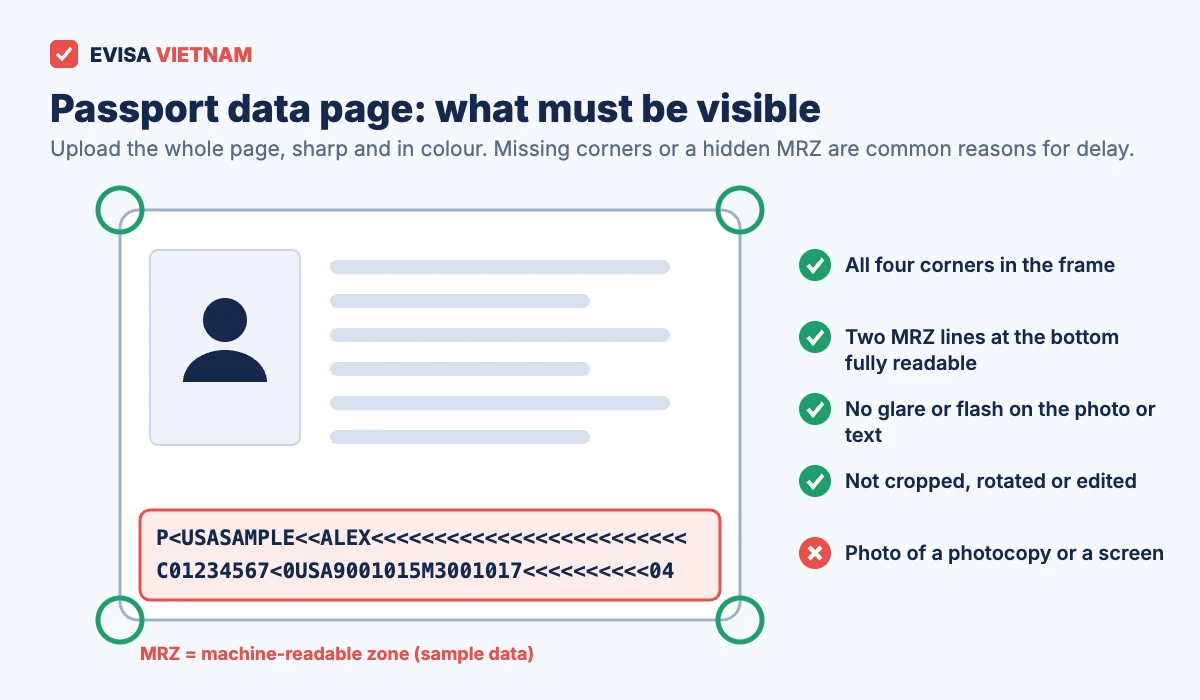
- Show the whole page, with all four corners inside the picture.
- Make sure the two lines of letters and numbers at the bottom (the machine-readable zone, or MRZ) are sharp and complete.
- Avoid flash. Light from a window at an angle stops glare on the plastic cover.
- Use the original passport, not a photocopy or a picture of a screen.
How to take a Vietnam visa photo at home
You do not need a studio. In fact, a phone and a white wall are enough if you follow these steps.
- Find the light. Stand facing a window during the day, about 50 cm in front of a white wall. This way, the wall stays bright and your face has no harsh shadows.
- Ask someone to hold the phone. The phone should be at eye level, about 1.5 m away. Then use a little zoom (around 2×) so your face is not stretched.
- Frame head and shoulders. Keep your face in the centre, with a small space above your head.
- Crop to 2:3. For example, crop to 800×1200 pixels or any larger size with the same shape.
- Save as JPG and check the size. Finally, make sure the file is under 2 MB. Most phone photos at normal quality are well below that once cropped.
Worked example: Anna takes a 3024×4032 photo on her phone. She crops a 1600×2400 area around her head and shoulders, which is exactly 2:3. Then she exports it as a JPG at 80% quality. The result is about 600 KB, so it is ready to upload.
Vietnam visa photo for visa on arrival and embassy visas
If you use visa on arrival, you will hand in printed photos at the airport counter along with your approval letter and the NA1 form. Therefore, print two 4×6 cm photos before you fly and glue one on the form. Some airports have photo services, but they are not always open, and they add time to an already slow queue. Our guide to the NA1 form and airport documents explains the full counter process.
Embassy visas follow similar rules. Still, each embassy can ask for its own photo format, so check the embassy’s own instructions before you print.
Photos for children and babies
Every traveler needs their own visa, so every child needs their own Vietnam visa photo. For babies, lay them on a white sheet and take the picture from above. Also, keep hands, toys and dummies out of the frame. A baby’s eyes should ideally be open, but a clear, well-lit face is the main goal.
What happens if your photo is not accepted?
Sometimes Immigration asks you to provide a new image instead of refusing the application. In that case, the request appears when you check your status with your registration code on the official portal. Upload a corrected file quickly, because the application waits until you respond.
If the e-visa is refused, however, you must apply again and pay the government fee again, because the fee is not refunded. That is why it pays to check the photo before you submit. If you prefer a second pair of eyes, our application service reviews your photo and passport page before submission. You can also apply directly yourself on the official portal, evisa.gov.vn.
For timing, see how long a Vietnam visa takes, and for fees, see our Vietnam visa cost guide.
FAQ: Vietnam visa photo
Can I use my passport photo for the Vietnam visa photo?
Only if you have the original digital file and it meets the rules above. Do not crop the picture from your passport page, because it will be too small and blurry.
Can I smile in my Vietnam visa photo?
Keep a neutral expression with your mouth closed. A slight natural look is fine, but avoid a wide smile.
Do I need to print photos for the e-visa?
No. For the Vietnam e-visa, you only upload files. You print the approved e-visa itself, not your photo.
Does the photo have to be exactly 4×6 cm?
For a digital file, what matters is the 2:3 shape and a clear face. For printed photos, print them at 4×6 cm.
What file size is accepted?
Keep the JPG under 2 MB. The upload form currently states this limit, although another page on the portal mentions a larger one. Staying under 2 MB works in both cases.
Sources: Vietnam National E-Visa Portal (evisa.gov.vn) instructions and upload form; Vietnam Immigration Department visa procedures. Last reviewed: 9 November 2026. We are an independent visa service, not a government website.
Vietnam Visa Processing Time 2026: How Long It Takes & When to Apply
The official Vietnam visa processing time for an e-visa is 3 working days after you submit the form and pay the fee. Weekends and Vietnamese public holidays do not count. In practice, most travelers receive their e-visa in 3 to 5 working days, and waits can be longer around Tet (Lunar New Year) and in peak months. So the safe plan is simple: apply 2 to 3 weeks before your flight.
This guide explains how the working days are counted, what slows an application down, the holiday periods to avoid, and what you can do if your trip is close.
Vietnam visa processing time in short (updated November 2026)
- E-visa: 3 working days officially; 3–5 working days is common.
- Visa approval letter (for visa on arrival): usually 2–3 working days through a licensed agency.
- Not counted: Saturdays, Sundays and public holidays in Vietnam.
- Best time to apply: 2–3 weeks before you travel.
- Urgent trip: check visa-free entry first, then talk to a service about faster options.
Vietnam visa processing time by visa type
Different routes take different amounts of time. The table below compares them, so you can pick the one that fits your dates.
| Route | Official or usual time | Notes |
|---|---|---|
| Visa exemption | None | No application if your passport and stay qualify. |
| E-visa on evisa.gov.vn | 3 working days (officially) | Often 3–5 working days; longer in peak periods. |
| E-visa through a service | Depends on the speed you choose | A service checks your form first; the government still decides. |
| Visa approval letter (visa on arrival) | Usually 2–3 working days | Then you collect the visa at the airport. |
| Embassy visa | Varies by embassy | Check the embassy’s own timing and opening days. |
First, check whether you need a visa at all in our list of countries exempted from Vietnam visa. If you do, the 90-day e-visa is the standard choice.
How the 3 working days are counted
The clock starts only when your application is complete and the fee is paid. After that, only working days in Vietnam count. For example, if you pay on a Friday, Day 1 is the following Monday.
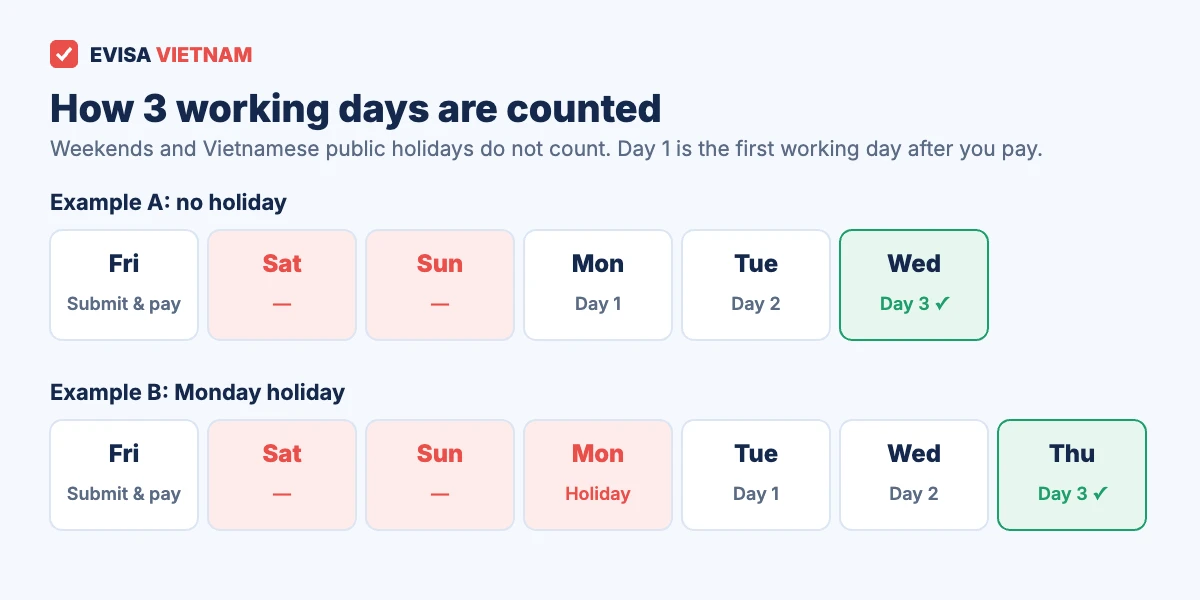
Remember that Vietnam is 7 hours ahead of GMT (UTC+7). As a result, a form sent on Friday evening in Europe or America arrives after the office day in Vietnam has ended.
When to apply for a Vietnam visa
Because the Vietnam visa processing time depends on working days and holidays, plan backwards from your flight date.
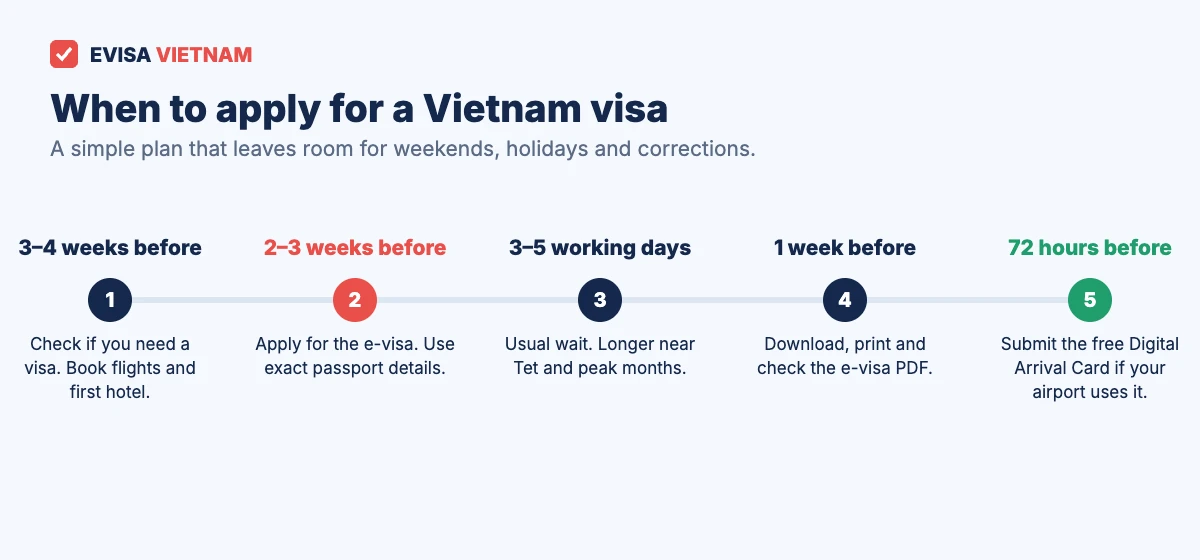
- 3–4 weeks before travel: check your visa needs and book your first hotel. You need an address in Vietnam for the form.
- 2–3 weeks before travel: apply. You choose the start date of the visa yourself, so applying early does not waste any validity.
- During processing: keep your registration code. You need it, with your email and date of birth, to check the status.
- About 1 week before travel: download and print the e-visa. Then check every letter and number against your passport.
- Within 72 hours of landing: submit the free Digital Arrival Card if your airport uses it.
Holidays that slow down the Vietnam visa processing time
Immigration offices close on public holidays, so applications wait. The longest break is Tet. For example, e-visa applications were not processed from 14 to 22 February 2026. Tet 2027 falls on 6 February 2027, so expect a similar pause around that week.
- New Year’s Day: 1 January.
- Tet (Lunar New Year): about a week, usually in late January or February.
- Hung Kings’ Commemoration Day: the 10th day of the 3rd lunar month (March or April).
- Reunification Day and Labour Day: 30 April and 1 May.
- National Day: 2 September, plus one extra day.
In addition, demand rises from December to March and in July and August. Therefore, add a few extra days if you travel then.
What makes an application take longer
- Photo problems: a portrait with glasses or a busy background often leads to a request for a new image. Read our Vietnam visa photo guide before you upload.
- Typing mistakes: a wrong passport number or name order can lead to refusal, and then the clock starts again.
- Missing address: leave no empty fields for your stay in Vietnam.
- Extra checks: some applications are reviewed by hand, which adds time.
What to do if your trip is very close
First, check whether you are visa-exempt; if so, you need nothing. Next, if you fly into an airport and time is short, a visa approval letter through a licensed agency can sometimes be arranged faster than a standard e-visa. Some services also offer faster e-visa handling. However, no private company can promise the government’s decision, so be careful with any website that guarantees approval.
If your e-visa still shows “processing” a few days before your flight, contact the service you used, or our team through the application page, and keep your registration code ready.
Worked example: planning a Christmas trip
Sam flies from London to Ho Chi Minh City on 20 December and stays 30 days. A UK passport is visa-free for 45 days, so Sam needs no visa. However, his friend Maya holds a US passport. She applies for the e-visa on Monday 30 November. Three working days later, on Thursday 3 December, her e-visa is usually ready. Even if it takes 5 working days, it is ready by Monday 7 December. That still leaves almost two weeks of margin before the flight.
FAQ: Vietnam visa processing time
Can I get a Vietnam e-visa in 24 hours?
The official time is 3 working days. Some services offer faster handling for urgent cases, but results depend on Immigration, so nobody can promise a set time.
Does the Vietnam visa processing time include weekends?
No. Only working days in Vietnam count.
How early can I apply?
You can apply well before travel, because you pick the start date. Two to three weeks ahead is a good balance.
Can I check my status?
Yes. Use the search page on evisa.gov.vn with your registration code, email and date of birth.
Does processing cost extra?
The government fee is US$25 for single entry or US$50 for multiple entry. See our Vietnam visa cost guide for every route.
Sources: Vietnam National E-Visa Portal (evisa.gov.vn) instructions; Vietnam Immigration Department notice on Tet 2026 processing; Vietnam public holiday calendar. Last reviewed: 9 November 2026. We are an independent visa service, not a government website.
Not finding what you are looking for?
Enter your email and start chat with us directly.
Chat with us
Email address
info@evisa-vietnam.com
Recent posts
-
 Who Is Exempted From Vietnam Visa? 2026 Visa-Free Countries List November 9, 2026
-
-
Vietnam Evisa 2026: Complete Guide to the 90-Day E-Visa November 9, 2026
Copyright © 2008 - 2026 · evisa-vietnam.com
We are neither a government website nor affiliated with the embassy. We are a commercial website for consulting & supporting to get a visa for Vietnam.
We are neither a government website nor affiliated with the embassy. We are a commercial website for consulting & supporting to get a visa for Vietnam.